
Company culture is one of the most overused yet least understood terms in business. Leaders and employees alike throw around words such as cultural fit, team vibe, values, and engagement, but too often those ideas remain surface-level.
The reality is that a thriving workplace environment is not a perk, a motivational poster, or free snacks in the break room. It is the invisible operating system that drives how your business functions day to day.
When done intentionally, this organizational framework becomes one of your company’s greatest assets. It shapes how decisions are made, how conflict is resolved, and how people treat each other when no one is watching.
A strong workplace dynamic has the power to improve operational efficiency, foster leadership development, and position your organization for long-term organizational growth. A weak one, on the other hand, slows progress, stifles innovation, and keeps the business dependent on the leader’s constant presence.
The question every business owner should ask is: does your environment work for you, or against you?
Table of Contents
Why Company Culture Should Work Even When You Are Not in the Office
Your organizational mindset does not clock out when you do. Whether you are taking a much-needed vacation, handling a family emergency, or simply shutting down your laptop for the evening, your team culture is still active. The way employees function in your absence is the clearest reflection of how strong or fragile it truly is.
A healthy team framework rooted in trust, clarity, and autonomy allows your employees to thrive without constant oversight. They understand the mission, feel empowered to make decisions, and collaborate effectively to solve problems.
This is how small and mid-sized businesses scale: by creating systems and values that support leadership at every level, not just from the top.
If your team struggles to function the moment you step away, that is a red flag. It means your culture relies too heavily on you, and that is not sustainable.
Sustainable growth requires an organizational ecosystem that carries the business forward whether you are present or not.
Leadership Sets the Tone, Whether You Realize It or Not

Leaders define the workplace climate, whether intentionally or not. Your style of communication, your response to mistakes, and your ability to model accountability are constantly being observed. If your leadership team is unclear, reactive, or inconsistent, expect those same behaviors to ripple throughout the organization.
Conversely, if leaders demonstrate resilience, empathy, and a commitment to operational excellence, those values take root in the team. Culture is not what you write in a handbook, it is what you demonstrate everyday.
Ask yourself and your leadership team:
- Do we consistently lead by example?
- Are we modeling the behaviors we expect from others?
- Do we create space for feedback, collaboration, and new ideas?
- Are we building trust or eroding it?
The answers to these questions reveal the real state of your organizational ethos. Awareness is the first step, but improvement requires deliberate action.
For a deeper dive into practical ways leaders can guide and inspire their teams, check out our post on Great Leadership: Building the Foundation of a Thriving Team.
How to Build a Workplace Environment That Thrives Without You
Here’s a quick visual summary of the practices that create a business framework strong enough to thrive when leadership steps away.
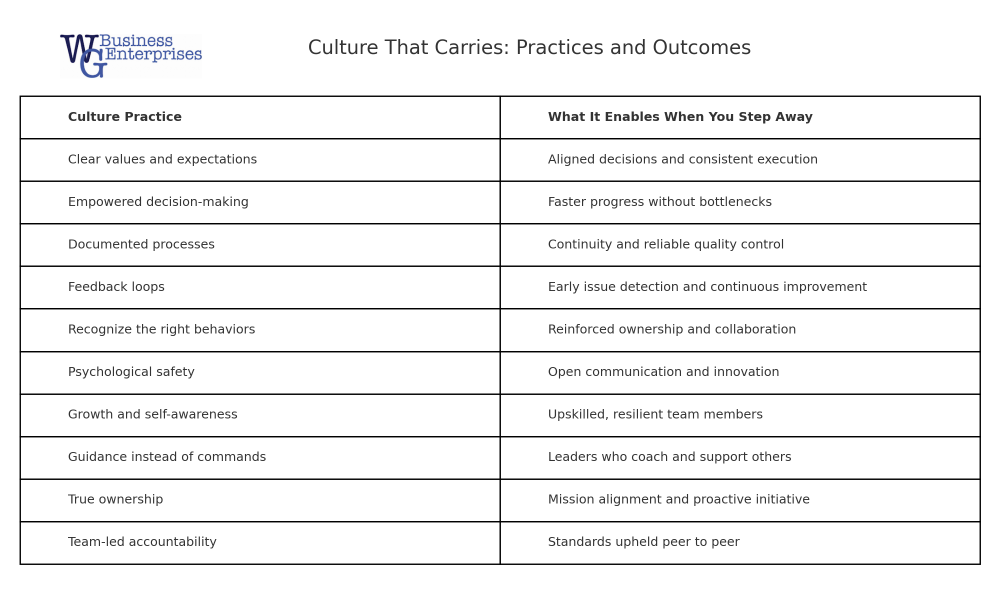
Building a resilient atmosphere is not an accident; it requires strategy, systems, and reinforcement. The following approaches ensure your business thrives even when you are not at the helm:
1. Establish Clear Values and Expectations
Your team cannot succeed if they do not understand what success looks like. Define your core values in a way that is actionable, and connect them to real examples of performance. Employees should know what great work looks like and how their role supports the overall mission.
2. Empower Decision-Making
Micromanagement is the enemy of growth. Equip your team with the tools, training, and authority to make decisions confidently. True leadership is not about holding every answer, it is about fostering trust and enabling others to lead.
3. Document and Share Processes
Strong culture is supported by strong systems. Document workflows, communication guidelines, and decision protocols so the business does not falter if someone is out. Standard operating procedures not only support consistency but also improve efficiency.
4. Create Feedback Loops
Encourage continuous feedback through surveys, one-on-one meetings, or platforms like 15Five. More importantly, act on the feedback. When employees see that their input leads to meaningful changes, trust deepens and engagement rises.
5. Recognize and Reward the Right Behaviors
Recognition reinforces values. Go beyond performance metrics and celebrate collaboration, adaptability, and initiative. Recognition builds momentum for the behaviors that strengthen your cultural DNA.
6. Foster Psychological Safety
An open-door policy is not enough. Employees need psychological safety, the assurance that they can speak up, admit mistakes, and share new ideas without fear of backlash. When safety is present, innovation and accountability thrive.
7. Encourage Growth and Self-Awareness
Personal development fuels business growth. Encourage your team to pursue ongoing training and self-reflection. A culture of growth asks both leaders and employees: how can I improve, and how can we improve together?
8. Lead with Guidance, Not Commands
The best leaders are coaches, not dictators. Provide mentorship, clarity, and support that inspires ownership and accountability. Leadership rooted in humility and empathy creates a culture people want to join and stay in.
9. Build True Ownership
Ownership creates care. When employees are included in setting goals, shaping initiatives, and celebrating wins, they naturally align with the mission. Shared ownership fosters deeper loyalty and higher performance.
10. Prioritize Team-Led Accountability
Accountability should come from within the team, not only from leadership. When peers hold each other to high standards, culture becomes self-sustaining and resilient.
A Workplace Ethos That Evolves With Your Business

The most effective company frameworks are never static. They are shaped by your people, refined by your systems, and tested by challenges.
A resilient workplace adapts as your business grows, whether you are managing a small consulting firm, scaling operations, or leading complex projects.
The key is to remain intentional. Without clear leadership, culture drifts. With the right structure, it becomes a competitive advantage that drives business strategy, operational efficiency, and leadership development.
If you are unsure about the health of your team dynamics, look at how your employees performs when you are not in the room. That is your company’s true culture.
Now is the time to build a system that carries. Because when your workplace thrives, your team thrives. And when your team thrives, your business achieves more than you ever imagined.
Frequently Asked Questions
1. What does “company culture” really mean?
It’s the shared set of values, behaviors, and systems that guide how your team works together. It goes beyond perks or policies. It’s how decisions are made, how people treat one another, and how the business runs when leadership is not in the room.
2. Why the workplace environment is important for small businesses?
For small and mid-sized businesses, the operating system is often the difference between growth and burnout. A strong one fosters collaboration, empowers employees to take ownership, and ensures the business can thrive even without constant oversight.
3. How do leaders shape the organizational mindset?
Leaders set the tone through their actions, communication style, and decision-making. Employees mirror leadership behavior, which is why consistency, and accountability are critical.
4. What are signs of a weak team dynamic?
Red flags include reliance on leaders relying for every decision, lack of trust among team members, unclear expectations, and high turnover. If productivity drops the moment leadership steps away, it’s a warning sign.
5. How can I start improving my company culture today?
Start by clarifying values, documenting processes, and empowering employees to make decisions. Encourage feedback, recognize the right behaviors, and model the mindset you want to see.
6. Can a consultant help us build a stronger framework?
Yes. A consultant brings outside perspective, proven systems, for leadership development, operations consulting, and process improvement. At WG Business Enterprises, we help leaders create sustainable environments that support growth.
Conclusion & Next Steps
Ready to build a culture that carries your business forward? Our team at WG Business Enterprises specializes in leadership development, operations consulting, and process improvement designed for small to mid-sized businesses.
Are you still unsure if outsourcing is the right move? Let’s discuss this on a Free Consultation where we can guide you and support you.
Tell us about your needs here and one of our consultants will reach out.
Serving West Palm Beach, Palm Beach County, and clients across the U.S.

Free Business Resources & E-books:
Guide to SMART Goals for Businesses
Guide to Optimizing Your Business
Guide to a Hassle-Free Office Move