

Project environments are complex and fast-moving. Without structure and oversight, organizations risk missed milestones, budget overruns, duplicated efforts, and misaligned priorities. Two critical roles help prevent these outcomes: the Project Management Office (PMO) and the Project Manager (PM).
Although closely related, these functions serve distinct purposes. Understanding their differences and how they complement one another is essential for delivering consistent, strategic project success.
Let’s take a look at five key differences that clarify the roles of PMOs vs project managers and show their shared impact on businesses.
Table of Contents
Project Management Office (PMO) vs Project Manager (PM)
Although project management office (PMO) and project manager (PM) sound quite similar, their roles are quite different as they work and interact with different parts of a business. A PMO is a more central function within a business that establishes project guidelines and governance, standardizes procedures, and makes sure that projects stay in alignment with a business’s plans and values. A project manager tracks and executes projects on a daily operations level to bring action and growth to a business. PMOs establish the overarching guidelines, procedures, and vision that a project manager uses to execute and complete projects.
Both roles are important for having a flourishing team. As Mark A. Phillipy notes in “Delivering business value: The most important aspect of project management,” “The whole purpose for project management (as well as portfolio and program management) is to execute work that provides increased value to the business or customer.” Both the roles of PMO and project manager create a diverse and well-rounded business in their own ways, making sure more than just milestones are hit. Having a PMO and a project manager brings value to a business by making sure all aspects of a business’s project management are growing so that customers continue seeing the value in the business.
Key Differences
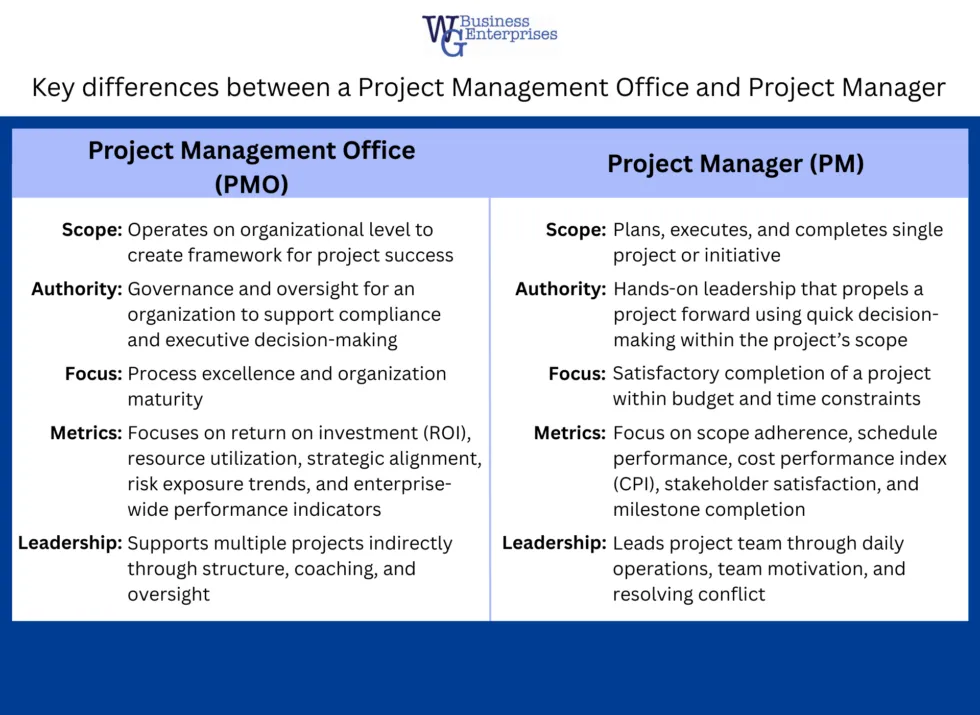
To better understand the roles of PMOs and project managers, here are five key differences that highlight their roles, how they operate, and how both roles coincide to produce long-term success and growth within a business:
1. Scope
The first main distinction between Project Management Offices and project managers is the scope and level of their work. The PMO operates at the organizational or portfolio level to establish the framework that enables projects to succeed. The PMO focuses on standardizing methodologies, allocating resources across portfolios, managing enterprise-level risks, and ensuring alignment with strategic objectives. In large organizations, a PMO may oversee dozens of concurrent initiatives, ranging from system implementations to marketing transformations, ensuring coordination, prioritization, and governance across all efforts.
On the other hand, the project manager focuses on a single initiative or a defined set of initiatives. The PM is accountable for planning, executing, and delivering the project according to scope, timeline, and budget. Responsibilities include stakeholder communication, risk mitigation, team coordination, and performance tracking.
Both the PMO and the PM are essential to a business’s success. Without the PMO’s portfolio oversight, projects risk becoming siloed and inconsistent. Without the Project Manager, strategic objectives remain unrealized at the execution level.
2. Authority and Governance
Another difference between the project management office and project managers is their authority. The PMO provides governance and oversight for a business. It defines standards, enforces compliance, approves methodologies and tools, monitors financial controls, and ensures lessons learned are captured and applied. The PMO typically reports to senior leadership and supports executive-level decision-making through consolidated reporting and portfolio analysis.
The Project Manager has a more hands-on role and holds authority within the boundaries of an assigned project. The PM leads the team, manages vendors, negotiates scope adjustments, and makes tactical decisions necessary to meet objectives. When cross-project conflicts arise, such as resource contention or escalations, the PM typically works with the PMO for resolution.
In short, the PMO defines and maintains the governance structure for projects, while the project manager operates within the structures to deliver outcomes.
3. Focus and Responsibility
The PMO and PM also have different focuses within an organization. The PMO emphasizes process excellence and organizational maturity. Its responsibilities include refining methodologies, implementing best practices, conducting training, maintaining performance dashboards, and continuously improving delivery standards. Metrics such as portfolio health, risk exposure, and earned value management (EVM) are tracked by the PMO.
The Project Manager focuses on delivering the agreed-upon outputs. While adhering to defined processes, the PM’s priority is achieving scope, schedule, and budget objectives. Daily stand-ups, change control, stakeholder engagement, and milestone tracking are central to this role.
Both the PMO and the PM’s roles coincide and their interdependence is critical. The PMO establishes the framework, standards, and governance that enable consistent execution across the organization. The Project Manager applies that structure to achieve timely, high-quality delivery at the project level. Without strong PMO oversight, projects risk inconsistency, duplicated effort, inefficient practices, and increased error rates. And without effective Project Managers driving execution, even well-designed processes can become rigid and disconnected from outcomes.
4. Metrics and Measurement
Measurement is another key differentiator between the project management office and project managers. Both roles track and analyze different metrics to ensure a business is functioning at its fullest capacity and is successful at all levels.
The PMO evaluates success at the portfolio level. Typical metrics that PMOs track include:
- Return on investment (ROI)
- Resource utilization
- Strategic alignment
- Risk exposure trends
- Enterprise-wide performance indicators
These metrics support forecasting, capital allocation decisions, and strategic pivots.
The Project Manager measures success at the project level, typically focusing on:
- Scope adherence
- Schedule performance
- Cost performance index (CPI)
- Stakeholder satisfaction
- Milestone completion
In summary, PMOs stack metrics for portfolio-wide performance and both long-term and strategic alignment, while project managers track metrics for individual projects to make sure that they are successful short-term. The PMO answers the question, “Are we investing in the right initiatives?” while project managers answer “Are we delivering this initiative successfully?”
5. Team Dynamics and Leadership
The team dynamics with a PMO and a project manager are also a key difference in their roles. The PMO typically consists of analysts, governance specialists, trainers, and methodology experts who support multiple projects indirectly. Their role is to enable delivery through structure, coaching, and oversight.
The Project Manager leads the assigned project team directly. This includes managing day-to-day coordination, resolving conflicts, motivating team members, aligning stakeholders, and ensuring accountability. The PM is responsible for team performance and cohesion throughout the project lifecycle.
The PMO scales expertise across the organization, while the PM applies that expertise to a specific initiative.
Frequently Asked Questions
1. What is a Project Management Office?
A project management office is a person or group of people that makes sure all projects are standardized, productive, and aligned with a business’s vision and goals. They created guidelines and systems to align and standardize projects so that they comply with a business’s policies and expectations.
2. What is a project manager?
A project manager is the leader and executor of a business’s projects. They work within the scope of daily operations to track and complete projects assigned to them. A project manager works hands-on with a project to plan, execute, and successfully complete a project in a timely manner within the project’s scope.
3. What is the main difference between a project management office and project manager?
The main difference between a PMO and a project manager is their position within a business. A PMO is a higher position that creates systems and guidelines to support daily operations. A project manager works closely with daily operations to execute projects to bring about business success.
4. Do small businesses need a project management office?
Small businesses may not need a full-time PMO but can still benefit from fractional PMO services. Fractional PMO services help small businesses with establishing project guidelines and standardizing procedures to align projects with a business’s vision and values.
5. Can a project manager function without a PMO?
Yes! Both project managers and PMOs can work without having the other since their roles and scope focus on different things. But be sure that your business has guidelines and systems in place so that projects stay standardized and aligned with your business goals.
A Complementary Partnership
The PMO and the Project Manager are distinct roles that coincide and work together to make a business thrive. Even though they play different roles in scope and authority, have different business focuses, track different metrics, and have different relationships within the business and their team, their roles work together to produce abounding success. When effectively aligned, the PMO provides strategic direction, governance, and consistency, while Project Managers convert that structure into measurable results that carry a business’s dreams into reality.
If you are looking for project management or fractional PMO services, WG Business Enterprises can help! We work closely with each of our clients to understand their business visions and goals, create systems and procedures that serve each business’s needs, and take projects from the dreaming stage to full completion. Contact us today and learn how WG Business Enterprises can manage your projects for rewarding and profitable success.
Serving West Palm Beach, Palm Beach County, and clients across the U.S.A

Free Business Resources & E-Books
Free Guide to SMART Goals for Businesses
Free Guide to Optimizing Your Business
Free Guide to Quarterly Checkpoints