

Sometimes the biggest improvements in business come from small, intentional adjustments. A fresh look at what is already working, and what is not, can reveal untapped opportunities for growth.
In today’s fast-moving market, adaptability is what separates thriving businesses from those that simply survive. You do not always need to reinvent the wheel or overhaul your entire operation to make more money. In fact, most profitable shifts begin with evaluating your systems, people, and strategies, then refining them step by step.
This guide walks you through practical, sustainable small business growth strategies to increase revenue and strengthen your foundation without adding unnecessary complexity.
Table of Contents
1. Take a Closer Look at Your Expenses
The first step in improving profitability is understanding where your money is going. Over time, many businesses accumulate expenses that no longer serve a clear purpose. Outdated software, unused subscriptions, and auto-renewing vendor contracts can quietly eat away at profits.
A good exercise is to review your last three to six months of business expenses and evaluate each one:
- Does this expense directly contribute to growth or operational efficiency?
- Are we still using this service or tool effectively?
- Can this be renegotiated, consolidated, or eliminated?
This exercise is not about cutting corners. It is about spending with intention. Every dollar should have a purpose.
Even modest adjustments, such as replacing multiple tools with one integrated platform, can free up capital for initiatives that drive measurable returns, such as marketing campaigns, technology upgrades, or team development.
An operations consulting approach that evaluates each cost against its business impact helps ensure that every expense supports your goals. Often, profitability improves not through expansion but through precision.
To dive deeper into how intentional spending connects to overall efficiency, explore our post on Business Optimization Tips: How To Run a More Efficient Operation.
2. Turn Everyday Problems Into Profitable Solutions
Every challenge inside your business represents an opportunity in disguise. When you shift your mindset from “problem-solving” to “solution-building,” innovation becomes part of how you operate.
For example:
- Teams that spend hours managing spreadsheets can benefit from automation tools or upgraded workflow systems that save time and labor costs.
- Repeated customer requests for services you do not yet offer may signal an opportunity to develop a complementary product or package.
- Communication breakdowns that delay projects can often be resolved through a structured project management system that improves coordination and client satisfaction.
These small shifts reduce inefficiencies and create new revenue opportunities. A business process improvement consultant might describe this as turning friction into fuel.
By transforming recurring pain points into scalable solutions, you not only save time but also build a stronger, more resilient business model.
Turning challenges into opportunities often starts with strong leadership. Learn more in our post on Effective Leadership Strategies.
3. Add or Evolve an Offer to Grow Revenue
Customer needs change over time, and so should your offers. One of the most effective ways to increase revenue is to refresh what you already provide or introduce something new that meets evolving expectations.
You do not need to reinvent your entire business model. Sometimes the smallest adjustments produce the biggest results. Consider the following ideas:
- Offering a premium version of an existing service for clients seeking more personalization or faster delivery.
- Bundling related services into packages that simplify decision-making and increase average order value.
- Creating digital add-ons such as templates, workshops, or training materials that provide ongoing value beyond the initial service.
- Launching a pilot program to test new ideas with a small audience before a full rollout.
These types of experiments often lead to major breakthroughs. The goal is not constant reinvention but continuous alignment. It is about adapting to what your customers need right now while staying true to your long-term vision.
4. Study the Competition with Strategy, Not Comparison

Competitor research is one of the fastest ways to identify new growth opportunities, but only when done strategically.
The goal is not to copy what others are doing but to understand the landscape so you can stand out more effectively.
Start by identifying three to five competitors and study them in two ways:
What They Are Doing Well:
- Offering loyalty programs or referral incentives
- Maintaining a strong presence on social media and through paid advertising
- Delivering smooth customer experiences such as easy booking, onboarding, or checkout
What They Are Missing:
- Personalized client engagement or relationship follow-up
- Educational content that builds authority, such as blogs or guides
- Partnerships or collaborations that expand audience reach
Once you have gathered insights, use them strategically. Match competitors in areas where they excel, but focus your energy on filling the gaps they have ignored. This balanced approach that combines awareness with originality is what drives innovation and long-term success.
5. Tap Into Your Team’s Ideas
Your employees often have the best insights into what is really happening in your business. They interact with clients, manage systems, and troubleshoot issues every day, giving them a perspective that leadership sometimes misses.
Encouraging their feedback not only improves efficiency but also builds trust and engagement. Here is how to put that into practice:
- Hold regular brainstorming sessions where team members share ideas for improving operations or enhancing customer experience.
- Create safe spaces for input through surveys or open suggestion channels so everyone feels comfortable contributing.
- Recognize valuable ideas and celebrate when employee contributions lead to measurable improvements.
Leaders who pair this with executive coaching or leadership development programs often see major gains in morale, innovation, and retention.
When employees see that their contributions are valued, engagement and innovation increase. Pairing this approach with leadership coaching or professional development programs amplifies results.
Empowered teams take ownership of outcomes, which strengthens both culture and performance.
6. Strengthen Systems with Smarter Tools and Technology
Technology, when chosen wisely, can be a quiet but powerful profit driver. The right systems reduce manual work, improve accuracy, and make scaling more efficient.
If your tools have not been updated recently, it is worth conducting a technology audit. Look for opportunities to:
- Implement project management platforms to track deliverables and deadlines in one place.
- Use CRM software to centralize communication and client data.
- Automate administrative tasks such as invoicing, scheduling, and reporting.
- Leverage data analytics dashboards to make informed real-time decisions.
Even small improvements, such as automating one recurring task, can compound over time into significant productivity gains.
Working with a fractional COO or operations consultant can help you identify which areas of your business will benefit most from these updates.
7. Improve Internal Processes Before Scaling
Growth is exciting, but scaling without structure can quickly lead to burnout and inefficiency. Before expanding, evaluate your core operations to make sure your foundation can handle higher demand.
Ask yourself:
- Are there clearly documented procedures for recurring tasks?
- Does your current team have the capacity to manage increased workloads?
- Are communication and approval workflows efficient and well understood?
Investing time in process optimization before scaling ensures your systems are strong and sustainable. It also protects your brand reputation by maintaining the same high-quality experience as your business grows.
8. Measure What Matters Most
You cannot improve what you do not measure. Tracking key performance indicators, or KPIs, gives you visibility into what is working, what is not, and where your efforts will have the greatest impact.
Data-driven decision-making transforms guesswork into strategy and ensures that every improvement you make is backed by evidence.
Some valuable KPIs to monitor include the following:
- Revenue per client or project to understand profitability on a per-customer basis.
- Client retention and satisfaction rates to measure loyalty and long-term value.
- Cost per lead or acquisition to evaluate marketing and sales efficiency.
- Operational efficiency metrics such as turnaround time, utilization rates, or error reduction.
Integrating analytics tools or dashboards into your daily operations allows you to identify trends early, pivot quickly, and allocate resources more effectively.
Many operations consulting firms now include real-time analytics integration as part of their strategy packages, giving leaders the clarity they need to make confident, data-informed decisions.
9. The Compound Effect of Small, Smart Shifts
Each of these strategies, whether focused on reducing waste, improving processes, empowering teams, or modernizing tools, may seem minor on their own. Yet when combined, they create a powerful compound effect that transforms a company from the inside out.
Refining one system naturally strengthens the next. Greater efficiency leads to stronger teamwork, improved offers enhance customer satisfaction, and better decision-making drives higher profit margins.
Small and consistent improvements are what lead to exponential results. The key is intentionality. Purposeful, steady adjustments build momentum over time and create lasting progress.
Every enhancement amplifies the one before it. Before long, the organization operates with sharper precision, stronger alignment, and greater profitability. Sustainable growth rarely happens overnight. It is the result of continuous and strategic refinement.
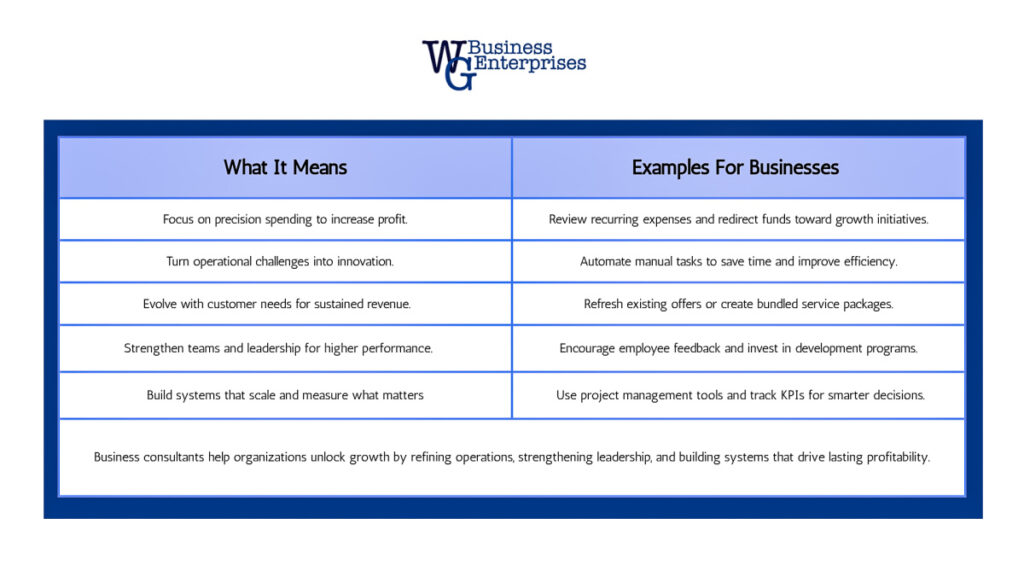
10. Ready to Grow Your Business the Smart Way?
Increasing revenue does not always require a complete transformation. Often, it is about viewing your business through a new lens and refining what already exists.
Strategic consulting can accelerate this process. Whether you need help with operations improvement, leadership development, project management optimization, or organizational growth strategy, a focused and data-informed plan can help you move forward with clarity and confidence.
By aligning your people, processes, and technology around a shared vision, you create a business that not only grows but sustains that growth over time.
Frequently Asked Questions About Boosting Business Revenue
1. What are the easiest ways to increase business revenue without major changes?
Start by identifying small operational improvements that deliver a measurable return. Review recurring expenses, streamline workflows, and evaluate your current offers. Many businesses see profit gains simply by reallocating funds from low-value areas to high-impact activities such as marketing, team training, or automation.
2. How can operations consulting services help improve profitability?
Operations consulting services focus on identifying inefficiencies in your day-to-day processes and finding smarter ways to work. Consultants analyze your systems, people, and tools to uncover bottlenecks and implement strategies that reduce waste, improve productivity, and support sustainable business growth.
3. What role does leadership play in increasing profits?
Strong leadership creates alignment across your organization. When leaders invest in coaching and clear communication, teams become more engaged, accountable, and innovative. This directly impacts performance, customer satisfaction, and profitability.
4. How can small businesses stay competitive without overextending resources?
Smaller organizations can compete effectively by focusing on precision and agility. Rather than trying to do everything, prioritize the activities that create the most value for your customers. Adopt a continuous improvement mindset by refining one process at a time, measure results, and build on what works.
5. What are key metrics every business should track to measure success?
Key performance indicators (KPIs) vary by industry, but most growing businesses benefit from tracking a few core metrics that reveal the overall health of their operations. These include revenue per client or project to understand profitability, client retention rate to measure loyalty and long-term value, cost per lead or acquisition to assess marketing efficiency, and operational metrics such as turnaround time or utilization rate to gauge productivity. Consistently monitoring these numbers provides valuable insight into performance, allowing leaders to make informed, data-driven decisions that guide future growth with confidence.
Closing & Next Steps
Big results often start with small shifts. Every improvement, no matter how minor, compounds into lasting impact when applied consistently and strategically.
If you are ready to:
- Evaluate your systems for efficiency,
- Strengthen your leadership and team performance, and
- Improve profitability across every level of your organization, then now is the perfect time to take action.
Our team can help you design a customized plan that aligns with your goals, identifies your highest-impact opportunities, and guides you step by step toward measurable growth.
Small changes. Smart strategy. Big profits. This is how sustainable success begins.
Schedule a free consultation with our team to discover how to apply these strategies effectively and unlock greater profitability for your business.
Serving West Palm Beach, Palm Beach County, and clients across the U.S.A.

Free Business Resources & E-Books
Guide to SMART Goals for Businesses
Guide to Optimizing Your Business
Guide to a Hassle-Free Office Move