
Is Your Business Thriving, or Just Getting By?
Every business owner eventually asks the same question: Am I running my business, or is my business running me?
If you find yourself constantly putting out fires, juggling inefficient systems, or struggling to scale without chaos, you are not alone. Many small and mid-sized business owners operate reactively instead of proactively.
The good news is there is a solution: business optimization.
Optimization goes beyond buzzwords. It is a practical strategy to lower expenses, increase efficiency, and position your business for sustainable growth.
Whether you are a solopreneur, a growing startup, or a mid-sized company, optimizing your operations can transform how you work. It frees up time, reduces stress, and unlocks growth opportunities.
Table of Contents
What Is Business Optimization?
In simple terms, business optimization is the process of refining how your company operates to maximize efficiency and profitability. It ensures that every part of your business, including people, processes, and technology, works together seamlessly.
Common areas of enhancement include:
- Streamlining workflows to reduce bottlenecks and wasted effort
- Upgrading outdated systems that slow down productivity
- Implementing automation and new technologies to save time
- Reallocating resources to focus on high-value activities
- Improving customer interactions to boost satisfaction and loyalty
The ultimate goal is to improve efficiency, minimize waste, reduce costs, and create more value with the same or fewer resources.
But optimization goes deeper than saving time or money. It is about building intentional systems across your operations, leadership, and decision-making so you can grow without disruption. Done well, optimization allows you to scale strategically, free up bandwidth for visionary leadership, and set the foundation for long-term success.
Instead of constantly scrambling to solve last-minute problems, an optimized business anticipates challenges and already has systems in place to keep things running smoothly. It is about working smarter, not harder.
What Business Optimization Actually Looks Like
1. Time Management
How much time does your team spend on repetitive, manual tasks? If you are still using spreadsheets for scheduling, manually entering data, or chasing down approvals, you are losing hours every week.
Refinement strategies:
- Automate repetitive tasks with software like Zapier or HubSpot
- Use project management tools such as Asana, Trello, or Monday.com
- Standardize processes with SOPs (Standard Operating Procedures)
- Batch tasks to reduce context switching
2. Technology and Software
Outdated technology does not just slow you down, it costs you money. From clunky CRMs to spreadsheets that crash, inefficient tools create frustration and errors.
Systematization strategies:
- Upgrade to cloud-based software for flexibility and collaboration
- Integrate systems such as CRM, accounting, and project management to eliminate duplicate data entry
- Adopt AI-powered tools for customer service, analytics, and forecasting
3. Labor Costs and Team Alignment
Having the wrong people in the wrong roles, or too many people doing overlapping work, creates inefficiency and turnover.
Optimization strategies:
- Conduct role audits to ensure responsibilities match strengths
- Cross-train employees to increase flexibility
- Use fractional or contract talent to fill gaps without overstaffing
- Implement performance management systems for accountability
4. Process Improvement
Clunky workflows drain time and resources. Business process improvement consulting helps identify inefficiencies, eliminate unnecessary steps, and redesign systems for smoother operations.
Improvement strategies:
- Map current workflows to identify bottlenecks
- Eliminate redundant approvals or manual handoffs
- Standardize processes across departments for consistency
- Continuously refine based on performance metrics
5. Customer Experience
Behind-the-scenes optimization directly impacts customer satisfaction. If your internal systems are messy, your customers will feel it through delays, errors, or poor communication.
Alignment strategies:
- Simplify the buying process with user-friendly platforms
- Implement CRM tools for personalized communication
- Use chatbots or AI for faster customer support
- Gather feedback regularly to identify friction points
The Added Value of a Fractional COO
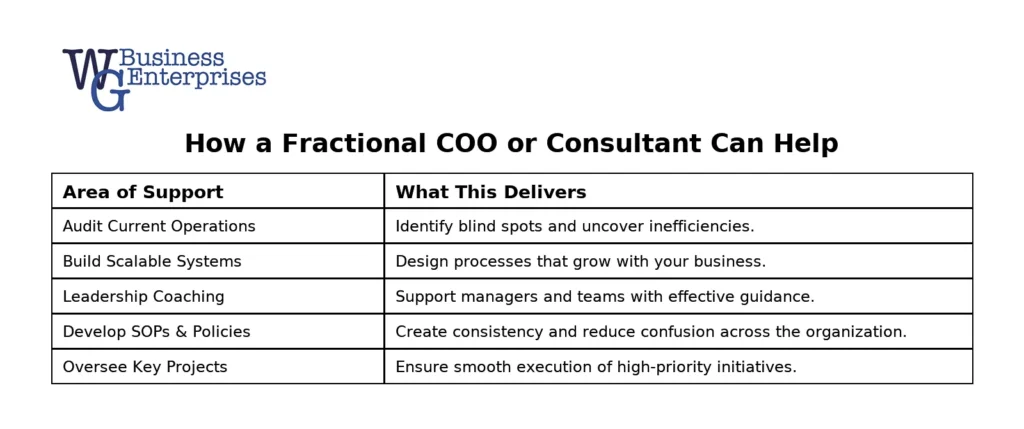
Bringing in outside expertise can accelerate results. A Fractional COO or business process improvement consultant helps uncover blind spots, design smarter systems, and implement improvements without the expense of hiring a full-time executive.
Beyond the chart above, here’s what they bring to your business:
- A fresh, unbiased perspective to spot inefficiencies leadership may overlook. It’s the kind of insight you gain from experienced operations consulting services.
- Access to industry best practices tailored to your unique business model, ensuring you stay competitive in your market.
- Proven frameworks for scaling a business without chaos or burnout, built on tested process improvement strategies.
- Accountability that turns vision into action, supported by leadership development coaching for managers and teams.
- Flexibility to engage only when and where you need expertise, through Fractional COO services designed for small and mid-sized businesses.
For many growing companies, hiring a full-time COO is too expensive. A fractional model provides the same executive-level guidance at a fraction of the cost. It is flexible, scalable, and tailored to your needs.
If you are exploring outside expertise, project management is another area where strategic support can accelerate results. Learn more in our post on Why Outsourcing Project Management Helps Businesses Thrive.
Why Optimization Matters for Your Business

Without a streamlined approach, businesses often face:
- Constant firefighting instead of strategic growth
- High employee turnover due to burnout or misalignment
- Rising costs from outdated systems and inefficiencies
- Missed opportunities because leadership is stuck in day-to-day tasks
- Frustrated customers who leave for smoother experiences elsewhere
With proper enhancements, businesses gain:
- Lower operating costs and reduced waste
- Stronger systems that scale without chaos
- Improved employee retention and productivity
- Increased profitability and competitiveness
- More time for leadership to focus on vision and strategy
In short, business optimization is the difference between surviving and thriving.
Many of the inefficiencies that hold businesses back are the same preventable mistakes entrepreneurs make in their early years. To see what pitfalls to avoid, read our guide on The Top 10 Mistakes New Businesses Should Avoid in Their First Five Years.
The Future of Business Optimization
Businesses that thrive in the future will be lean, adaptable, and forward-thinking. Optimization is not a one-time fix, it is an ongoing mindset.
The most successful companies will:
- Regularly evaluate and improve workflows
- Adopt technology that improves efficiency
- Build leadership teams capable of scaling sustainably
- Stay nimble enough to pivot with confidence
Optimization is your secret weapon for growth, clarity, and sustainability. It helps you work less while achieving more.
Frequently Asked Questions About Business Streamlining
1. What does it mean to optimize a business?
It’s the process of refining your business operations, systems, and workflows to make them more efficient and cost-effective.
2. Why is business process improvement important?
Because it reduces wasted time, lowers costs, and prevents burnout. It also ensures your business can serve customers better and scale effectively.
3. How do I know if my business needs fine-tuning?
If you feel like you are always putting out fires, struggling with turnover, or missing growth opportunities, it is time to optimize.
4. What is a Fractional COO and how can they help?
A Fractional COO is a part-time operations leader who supports small and mid-sized businesses with strategy, systems and execution.
5. What are the benefits of systematization?
The benefits of optimizing operations include lowering operating costs, freeing up leadership time for strategic planning, and increasing both profitability and scalability. It also helps improve employee retention and satisfaction while enhancing the overall customer experience and loyalty.
6. Is optimization a one-time project or an ongoing process?
Optimization is not a set-it-and-forget-it activity. It is an ongoing process that requires regular evaluation of systems, technology, and team alignment. The most successful businesses treat optimization as part of their culture.
7. How can small businesses afford optimization services?
Small businesses can access optimization expertise through flexible consulting models such as Fractional COO services or project-based consulting. These options provide high-level guidance without the overhead of a full-time executive team.
8. How long does it take to see results?
The timeline depends on the scope of the changes. Some businesses see immediate improvements by automating repetitive tasks or upgrading software. Larger process overhauls may take months, but the return on investment usually comes quickly.
9. What industries benefit most from streamlining ?
Every industry benefits. Professional services, healthcare, e-commerce, manufacturing, and technology companies all gain efficiency, profitability, and scalability from optimization.
10. Can optimization help prepare for scaling?
Yes. Optimization creates the systems and structure you need to grow with stability. By streamlining operations before scaling, you avoid bottlenecks, burnout, and costly mistakes.
Ready to Optimize with Confidence?
If you are ready to take the next step toward true business optimization, WG Business Enterprises is here to help. Our team will audit your workflows, uncover areas for improvement, and guide you in building systems that save time, cut costs, and support long-term growth.
Your business should not run you. With the right optimization strategies, you can run your business with clarity, confidence, and sustainable success.
Consider downloading our FREE E-book, The Top 12 Things to Evaluate to Optimize Your Business. It’s a practical checklist designed to help you streamline operations and boost your bottom line.
Let’s discuss this on a Free Consultation where we can guide you and support you.
Serving West Palm Beach, Palm Beach County, and clients across the U.S.

Free Business Resources & E-Books
Guide to SMART Goals for Businesses
Guide to Optimizing Your Business
Guide to a Hassle-Free Office Move