

Running a growing business is exhilarating, but as order volume, client demands, and team sizes expand, many founders find themselves trapped in daily operations. Instead of driving long-term strategy, business development, and vision, leadership time gets consumed by troubleshooting workflows, putting out fires, and answering endless operational questions.
When an owner becomes the primary bottleneck in their own company, growth stalls.
For large enterprises, the solution is straightforward: hire an experienced Chief Operating Officer. For small to mid-sized businesses, however, bringing on a full-time, six-figure executive often does not make financial sense. That is where a Fractional Chief Operating Officer (fCOO) provides a high-impact, cost-effective alternative.
Here is what business owners need to know about what a Fractional COO does, the signs it is time to bring one in, and how flexible executive leadership can unlock sustainable growth.
Table of Contents
Fractional Chief Operating Officer (COO) defined
A Chief Operating Officer (COO) is an experienced operations executive who provides high-level strategic leadership, system architecture, and operational management on a part-time, retainer, or project basis. The ‘f’ in fCOO stands for “fractional”, and refers to the part-time nature of their role, a distinction that will be important when considering your company’s budget and overall needs.
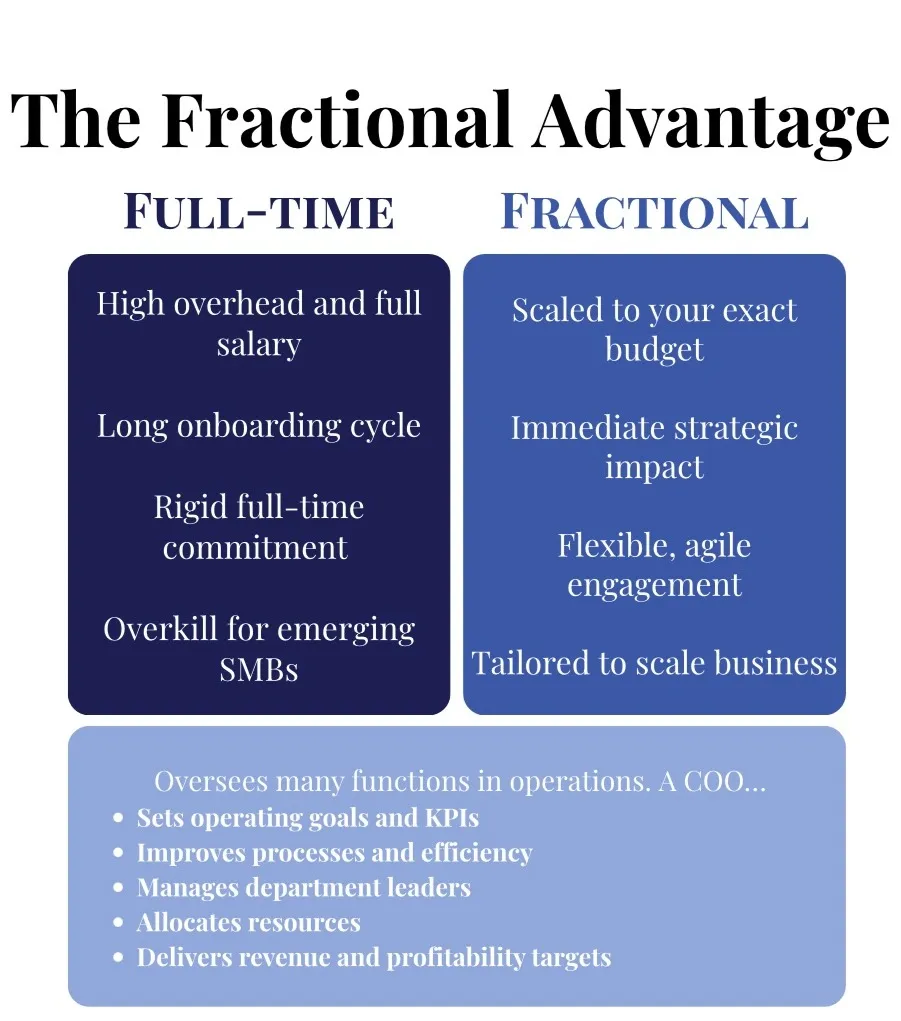
What Does a COO Do in a Growing Business?
While the Chief Executive Officer (CEO) defines the vision, culture, and overarching direction of the company, the COO’s primary responsibility is execution, translating high-level vision into efficient, day-to-day operations. fCOOs function as on-call senior specialty, fit for whatever your projects and daily operations need. Because they work part-time, you’ll be able to set an optimal schedule suiting the business’ needs. Their role can be temporary or long term, making their support very flexible. A Fractional COO steps in to oversee and optimize core business functions, including:
Workflow Optimization: Analyzing and improving processes that impact productivity and revenue. Auditing bottlenecks and creating standard operating procedures (SOPs) that ensure consistent delivery.
KPI Tracking: Establishing key performance indicators (KPIs) to measure operations efficiency, margins, and output across departments.
Team Accountability: Structuring roles, clarifying responsibilities, and ensuring team members execute tasks without requiring owner oversight. Evaluating team leadership capabilities.
Technology & Systems Integration: Selecting and implementing software solutions (CRMs, project management tools, ERPs) that support workflow automation.
Resource & Budget Allocation: Aligning operational spending and human capital with strategic revenue targets.
The Key Benefits of Hiring a Fractional COO
1. Strategic Leadership at a Fraction of the Cost
Hiring an executive full-time requires substantial overhead. A Fractional COO provides senior-level expertise on a flexible monthly retainer or project scope, optimizing operational budget while delivering clear ROI.
2. Objective Operational Perspective
When business owners work in the business every day, spotting internal blind spots becomes difficult. An outside operations executive assesses company workflows, software, and team structures with complete objectivity, identifying what is working, what is redundant, and where profit is being lost.
3. Scalable Systems and Team Mentorship
A skilled Fractional COO does not just solve immediate problems, they build sustainable systems. By training emerging managers, mentoring internal team leads, and establishing clear accountability frameworks, they build an infrastructure that runs smoothly even as volume multiplies.

Spotting the issues: signs you need a fCOO
If you’re a small business owner, you know the struggle of feeling like any bad decision could set you back for months; and when you’re stuck in a negative ROI, there’s no room for error. Still, you might be in desperate need of a Chief Operating Officer and not know it.
Former COO Jhana Li spoke about this topic on Katie Brinkley’s Rocky Mountain Marketing podcast, and she outlines four core resources a company uses every day–the resources operations work to optimize so they are ROI positive: Time, Energy, Money, and Human Potential. Issues across these resources is a sign you need operational help. While these aren’t the only resources, they are a good place to start your diagnosis. We can zoom in to these resources to evaluate cracks that start to show.
Time – The Founder Is the Operational Bottleneck
- Time is wasted on low-value tasks. CEO is constantly:
- The only person capable of answering routine team questions
- Reviewing line-item tasks
- Micromanaging delivery schedules
- Sending invoices
- Is the only person who can answer questions
When there is no time left to focus on partnerships, high-value client relationships, or business development, high-level operational support is needed.
Energy – Constant Firefighting, Impending Burnout
- When operations lack clear structure, leadership energy is drained by:
- Recurring emergencies
- Missed deadlines
- Inconsistent delivery
- Distractions below leadership responsibility
If daily management feels overwhelming, it indicates that processes and policies must be formalized to reduce owner dependency and boost morale.
Money – High Revenue, Low Profits
- A business can generate strong top-line sales, yet struggle with low margins due to:
- Inefficient workflow
- Unused software subscriptions
- Operational waste
- Poor resource allocation.
- Unstable investments
A Fractional COO audits operational expenses and tightens delivery mechanics to ensure revenue growth translates directly to bottom-line profit.
Human Potential/Team Capacity – No Autonomy or Accountability
- A team should have:
- Productive habits
- Proactive attitude
- Clear standards for operating procedures
- Well-defined metrics
- Unambiguous ownership
- Problem solving skills
- Clear parameters
If employees must ask for permission on every decision, or if projects regularly stall between handoffs, the organization requires leadership to establish clear operational systems and role accountability.
Why does this matter? Operations have to work to optimize these resources, and if there’s an issue with any of these, your business will suffer. Jhana Li explains “your business needs you to show up as the CEO, not as operations manager. You should be thinking about business opportunities, revenue generators, big picture stuff.” The operator’s job is to take your vision and reverse engineer it into a detailed, executable plan. More on Brinkley’s podcast.
You don’t need to diagnose the issue by yourself. A business has more than four resources, such as sales, land, labor, capital, and elements like vision and strategy. With so many moving parts, it can be difficult to pinpoint what the issue is and where it comes from. This is the role of a fCOO in your business.
Not ready?
“I’m not sure I’m ready for a COO” is an understandable sentiment. Rest assured, there are levels to operations expertise, and you don’t need to overwhelm yourself by paying for a level of expertise unnecessary for the stage of business growth you are in. If you have a small business, you can aim for help closer to your level, such as an operations manager or a coordinator. Should your business expand to a level higher, you would opt for a head of operations.
No matter the level, the core function of operations is the same: analyze and remedy issues. You as CEO should not be focused on those gaps, how to fix them, etc, in order to focus on the work that is otherwise hindered by these flaws in operations. It can be an intimidating hire, yet is worth the investment.
Even with steady footing, scaling your small business can be scary. Before you know it, the choices blur before you and you’re paralyzed. We get it, and we’re here to help. We know scaling takes strategy, stability, and discernment. Our business consultation services can give you the security to make the right choices for your company’s growth. In the meantime, read our article on the Top 5 Mistakes Small Businesses Make When Scaling to give you a head start.
Frequently Asked Questions:
1. Is my business too small for a fractional Chief Operating Officer?
For most growing small businesses, a fractional COO delivers immediate operational impact to diagnose challenges involving systems, processes, accountability, or execution. If you already see problems in your company’s core resources, it is a good idea to get operational help.
2. How do I know my business needs a fractional COO?
An fCOO is an ideal choice for operations leadership for small businesses that need structure, accountability, and strategic execution without the cost of a full-time executive. If you feel like a bottleneck, your growth has slowed, you lack the necessary structure to scale, or your strategic plans aren’t executed as you wanted, it may be time to hire a COO. Scaling a business should not come at the cost of burnout, operational chaos, or compromised quality.
3. Why fractional?
Fractional COOs can allow small businesses to access high-level operational expertise without feeling overwhelmed by the cost. It allows for better flexibility, allowing you to decide what the fCOO can target. Even in the short-term, fCOOs can contribute to your company’s long-term financial stability. fCOOs can be paid per project, via monthly retainer, or an hourly rate, contrasting the salary of a full-time employee. This, combined with an fCOO’s senior expertise, makes said full-time employee out to be a steeper investment.
4. Is a COO my only option for operations help?
No, based on your budget, or even a more specific need, you could look into other operations roles, i.e. Logistics Coordinator, Procurement Specialist, Operation Manager, Director of Operations, Business Operations Manager, Operations Analyst, Project Coordinator.
5. Why hire a COO instead of replacing team members?
Especially in a small business, people power the machine. Unlike cogs, however, they are capable of growth and change. Replacing entire teams can cause more chaos; an experienced eye makes for a clearer evaluation of your manpower, and ultimately a better investment in the long-run.
6. Can a COO work as a mentor?
One of the roles a COO has is holding teams accountable for operational efficiency. Their expertise and seniority makes mentoring possible. Since their knowledge is key to diagnosing issues in the company, they can train younger employees to spot these problems as well. An fCOO can guide a young leadership team, a CEO-in-training, or even a family member who is set to inherit the family business. Mentoring is a difficult job that can cause conflict between employees and family members, making a respectable expert the perfect choice to prune your current branches–a far better option than scrambling to hire new people on a whim.
Why WGBE?
At WG Business Enterprises, we go beyond high-level advising. We work alongside business owners to implement real operational change that drives measurable results.
Our approach is hands-on and tailored to each business. We do not apply one-size-fits-all solutions. Instead, we assess your current operations, identify the root causes of inefficiencies, and build customized systems that align with your goals and growth stage.
With WGBE, you gain:
- A strategic partner who helps execute, not just advise
- Customized operational frameworks designed for your business
- Clear accountability systems to improve team performance
- Support with daily operations, systems, and strategic execution
- Ongoing guidance to support long-term sustainability and growth
At WGBE, we provide hands-on Fractional COO and business operations consulting designed to build resilient systems, streamline workflows, and drive operational performance. Whether you need an executive partner to restructure your operations, lead complex projects, or free up leadership capacity, we deliver tailored solutions that impact your bottom line.
Next Steps
Ready to build an operation that runs with clarity and efficiency?
- Evaluate your current operations with our Free Business Assessment.
- Explore our specialized Fractional COO Services.
- Schedule a Consultation Call today to discuss your operational roadmap.
Free Business Resources & E-Books
Free Guide to SMART Goals for Businesses
Free Guide to Optimizing Your Business
Free Guide to Quarterly Checkpoints
Connect with Us on Social Media