

As your business grows, you may find yourself spending less time leading and more time coordinating people, solving operational problems, or chasing updates; at this point, you may need additional leadership support. You hear about Chief of Staffs and COOs, but which should you hire? The short answer: A fractional COO helps the business operate more efficiently, while a fractional Chief of Staff helps the CEO lead more effectively. This article will expand the differences to help you make the best choice for your business.
Table of Contents
Fractional Chief Operating Officer (fCOO)
A Chief Operating Officer is a professional operations leader who works to improve daily operations and help with business growth: providing high-level strategic support, scaling a business, risk mitigation, and creating strategies to improve operations and create efficiency. “Fractional” refers to the part-time nature of their role, a distinction that will be important when considering your company’s budget and overall needs.
fCOO responsibilities
A COO is responsible for making sure the company executes effectively. They oversee many functions, such as:
- Operations
- Sales or customer success
- Manufacturing or service delivery
- HR
- Finance
Their responsibilities include, but are not limited to:
- Set operating goals and KPIs
- Improve processes and efficiency
- Manage department leaders
- Allocate resources
- Deliver revenue and profitability targets
Notice the focus on owning departments, and less on CEO leadership.
Benefits of having a fCOO on board
- Expertise
- Quick way to recruit an expert to your team, no training or long-term investment needed. No need for an extensive onboarding process or job listings.
- As an outsider, a fCOO can bring a fresh pair of eyes to your team, bringing a variety of valuable experience to the table; they may be able to point out weaknesses in your existing processes and help you create plans to benefit the business in the long-term.
- Flexible Support
- fCOOs function as on-call senior specialty, fit for whatever your projects and daily operations need. Because they work part-time, you’ll be able to set an optimal schedule suiting the business’ needs. Their role can be temporary or long term.
- Cost effective
- The affordability of a fCOO makes it a great option to gain expert leadership. fCOOs can be paid per project, via monthly retainer, or an hourly rate, contrasting the salary of a full-time employee. This, combined with an fCOO’s senior expertise, makes said full-time employee out to be a steeper investment.
Limitations of a fCOO
- Limited availability
- As a fractional COO has multiple engagements and responsibilities, overlapped scheduling between companies would mean they may not be available for unexpected time-sensitive tasks.
- Intraorganizational awkwardness
- While being a great help, a fCOO is still an external partner. Despite their vast knowledge and experience, they won’t exactly know all the inner-workings of your business culture which could cause minor conflict.
- Interpersonal conflict can spark from stubborn executives who may not take as kindly to a contractor. The ability to acclimate to a work culture enough to integrate is not realistic for a fractional COO. If this tension is your biggest concern, but would still benefit from the role’s pros, consider a Full-Time COO.
When is a fCOO a better fit?
- Issues with an operating model problem
- Existing systems are not working as they should
- Structures are causing stress and clash with each other
- Productivity does not flow as planned
- Projects are suffering
- Projects fall behind because of vague ownership
- Employees are uncertain about responsibility
- Leaders are not executing their goals effectively
- Large gaps in the business
- Departments are not communicating effectively
- The business needs KPIs, procedures, or accountability systems
- Growth is creating stress instead of improving profitability
A fCOO uses their experience and critical thinking skills to see gaps in productivity or logistics, the cause, and helps to redirect accordingly. Because of their seniority and fresh perspective, a fCOO is likely to diagnose and treat the issue by applying what they have seen work for other companies in real time.
Suppose your company has great projects; operations are thriving, productivity is perfect, and interdepartmental communication is effective. Yet you still find yourself spread thin, struggling to catch up with updates, and too many decisions are left up to you. You may want to consider having a Chief of Staff on board, instead.
Fractional Chief of Staff (fCoS)
A Chief of Staff is appointed as a sort of right-hand to the CEO or Chair of a company. It is a position with many facets, all to serve the purpose of lessening some burdens, while advising and representing the CEO as needed. This is not the same as a direct second-in-command or CFO, as the fCoS has to flexibly work with strategy, operations, and communications, present at meetings and manage team priorities based on the CEO’s goals for that week.
A Chief of Staff should be able to conduct research, offer objective insight, evaluate proposals, facilitate executive decision-making, coordinate meetings, catalyse internal communication, and report back to the executive level. The fCoS therefore acts as an extension to the CEO’s efforts, allowing the CEO to tackle more pressing matters.
fCoS responsibilities
A fCoS is the CEO’s partner, present for daily tasks to make sure the executive leadership is able to work effectively.
Typical responsibilities:
- Prepare the CEO for meetings and decisions
- Drive cross-functional strategic initiatives
- Ensure priorities don’t fall through the cracks
- Coordinate communication between executives
- Track important projects
- Manage the CEO’s time and focus
- Lead special projects above the operations level
Notice the focus on the CEO’s leadership, and less on owning departments.
Benefits of having a fCoS on board
- An extension of yourself
- You delegate authority to the fCoS to represent you and make decisions on your behalf as necessary. The fCoS is able to act as a gatekeeper and filter; they decide if a request is worth escalating to you. They are able to stand in multiple meetings and only report the necessary, because they know your standards specifically.
- A fresh perspective
- A fCoS must get to know you and your goals in order to advise you more personally. An experienced fCoS will be able to observe the work culture, business habits and output, and dedicate time to understand the executive level of your business to best align the company with your interests. They are not a yes-man, however, and you can trust that they will use this knowledge and past experience to be your voice of reason.
Limitations of a fCoS
- An extension of yourself
- The fCoS has borrowed authority and is more directly involved in the executive level. Perhaps you are spread thin not because of communications, but because of operations and logistics. You may not need a representative, rather someone to assess and push back on how things function currently. If you prefer to tackle the problem yourself, a professional specializing in that department may be a better fit.
- Role ambiguity
- Due to the flexibility of the role, hiring a fCoS with uncertainty as to how you need them can cause more confusion for an already busy CEO. Getting to know the fCoS’s strengths and personality for the sake of appointing them takes time you may not have.
- Delegating authority vaguely can cause conflict in the workplace, especially if the fCoS does not get on well. If these lines are not drawn clearly, a fCoS could struggle to take responsibility appropriately, whether too much or not enough.
- Longer time investment
- To work effectively, they need to know every priority shift, stakeholder, meeting discussions, and the CEOs shifting concerns by the week. It is possible to have a lower maintenance fCoS, meeting with the CEO weekly, coordinate quarterly planning, and run strategic initiatives; Their work will just have a narrower scope.
If time worries you, consider hiring a fractional Chief of Staff. We have more information about our fractional Chief of Staff services here.
When is a fCoS a better fit?
- Workflow issues at the executive level
- A CEO that is spread too thin will spend time on things that could be easily delegated, causing the quality of more important tasks to suffer.
- The CEO wants to lead more effectively
- The CEO wants only pressing matters to be escalated to themself, while the rest is handled by someone they can trust in a reasonable and limited capacity
- Micromanagement
- The CEO is spending too much time in meetings
- Important decisions are not being followed through, strategic initiatives are being discussed but not completed
- The CEO needs help organizing competing priorities
- Communication issues
- Leadership meetings lack structure and follow-up
- The CEO needs a trusted person to coordinate across departments
- The organization needs better communication from the executive level.
Weighing the nuances: how do they truly compare?
fCOOs and fCoSs do not just differ in matters of authority, as the nature of their roles require completely different perspectives. Suppose your business is set to launch a new product in a few months: Both the fCOO and fCoS would have different concerns on the matter.
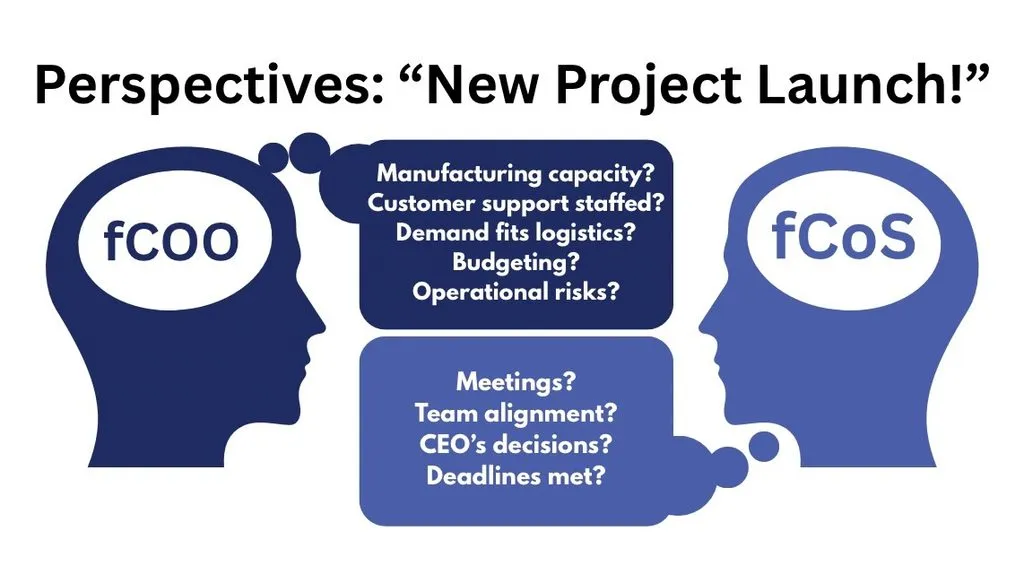
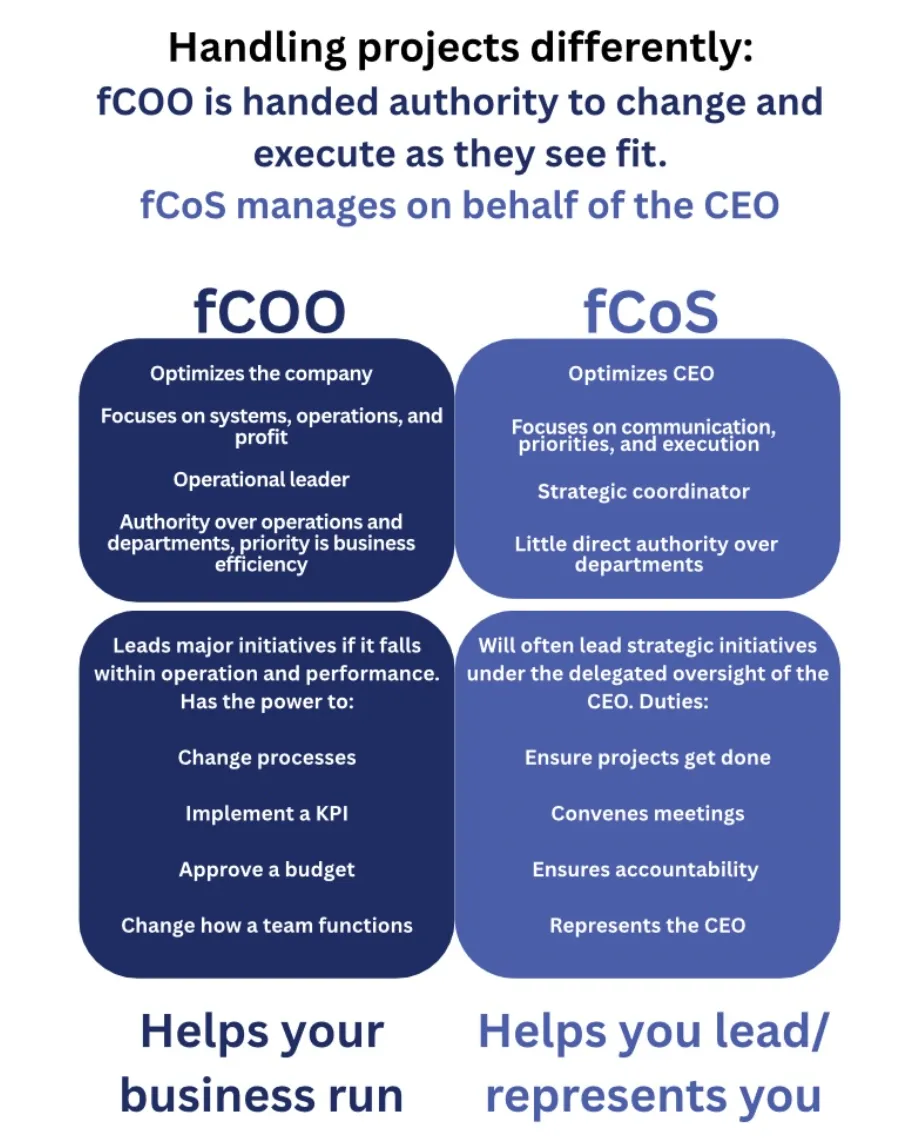
A fCOO owns the operation success of implementation, assigns resources, decides how teams will work, holds department leaders accountable, and can decide if a project is beneficial to a business’s overall goals and output.
In a sense, a fCOO is more responsible for the outcome of a project, as they have more responsibility to make authoritative decisions. Compare this to the fCoS’s more direct, “right hand man” role.
A fCoS’s focus is to ensure the CEO’s vision is reflected in the project; they may be tasked with coordinating leaders from sales, marketing, and customer success. They may also track milestones and surface risks, run committee meetings, and escalate issues to the CEO when decisions are needed. They can think ahead to what decision should be made next.
These strengths can work together. You don’t have to pick one. Having both a fCOO and fCoS on board can give you the piece of mind that each role is being taken care of to its fullest potential. The two roles can absolutely work hand-in-hand.
To help put this into perspective, let’s reflect back on the earlier example of a new product launch: your company has come out with a smart espresso machine.
The fCOO would establish operating rhythms and KPIs across sales, customer support, engineering, and finance. They would also monitor metrics such as unit sales, app adoption, machine failure rates, manufacturing costs, inventory, and so on. They could also put certain processes in place for issues such as warranty claims, supply shortages, and firmware updates.
The fractional Chief of Staff’s focus would more narrowly be on the CEO/leadership team’s effectiveness. This includes organizing strategic decisions, evaluating priorities (ex. Retail expansion or consumer sales?), prepare board updates, and ensure decisions are communicated and followed through across the board. A lot of the fCoS’s responsibilities are related to coordination.
While this example is meant to practically apply these roles in a hypothetical, it is important to keep in mind that these roles are not bound to the aforementioned responsibilities. Both the fCOO and fCoS work to optimize the company based on the CEO’s wishes, therefore allowing leadership to dictate the part they play.
Which one do I need?
Knowing how the person in each role tackles problems will be a great help in assessing what your business truly needs. Remember both roles are flexible and don’t always have to have the exact responsibilities and tasks listed previously. That being said, it is important to clarify the role more definitively to avoid confusion for yourself and the workplace. Consider these questions:
- Who do I want this person to report to?
- What decisions do I want them to make independently?
- Can they direct department leaders?
- Can they change processes or approve spending?
- Do I want them responsible for results or coordination?
- How will they handle disagreements with executive leadership?
- How will this role work with the rest of the team?
- What is the biggest help they provide to me and my business and operations?
So, should I hire a fractional COO or a fractional Chief of Staff?
Consider a fractional COO if your business is struggling with inconsistent processes, missed deadlines, unclear accountability, disconnected departments, or growth that is creating more stress than profitability. (Still unsure? Read our article that outlines 5 signs its time to hire a fCOO.)
Consider a fractional Chief of Staff if the CEO is overwhelmed by meetings, competing priorities, decisions that do not receive follow-through, or communication gaps across leadership.
Consider both only when your business has enough complexity to require both operational ownership and dedicated executive-level coordination.
Frequently Asked Questions:
1. How should I pick between a fCOO and a fCoS?
If your biggest challenge is building a business that can run properly, hire someone with strong COO capabilities. If your biggest challenge is building a business that doesn’t need your micromanagement, hire someone with strong Chief of Staff capabilities.The easiest way is to diagnose the broader issue; the last few times your company failed to meet an expectation, was it because of inadequate systems, or distracted executive leadership?
2. What size business should hire a fractional COO?
Any small or medium-sized business can greatly benefit from hiring an fCOO. If you have a growing team, a complex business, or a demand that is outgrowing your capacity, an fCOO can supply the support and structure needed to make sure your business is running smoothly to face any challenge it encounters.
3. Can a Chief of Staff be fractional?
Yes, a fCoS can be fractional. Keep in mind what role you want the CoS to play in order to optimize their time working for you. You engage a strategic partner for a set number of hours or days per month. It’s flexible, cost-effective, and scalable as your business grows. For more information on a fCoS, read our article about it here.
4. Can either work remotely?
Yes, most fractional operations leaders work virtually or hybrid, using digital
tools to stay fully integrated with your team.
5. Can a small business hire a fCOO and a CoS?
For most growing small businesses, a fractional COO may deliver more immediate operational impact when the primary challenges involve systems, processes, accountability, or operational execution. A Chief of Staff may be the better choice when the CEO is spending most of their time coordinating people, managing priorities, and ensuring strategic initiatives move forward. Onboarding both could absolutely be beneficial to ensure a steadier, more organized growth path for a small business.
6. How soon will they make an impact on my business?
Usually within the first few weeks, as they identify bottlenecks and implement systems that bring measurable progress
Next Steps
If you are ready for advice on whether to hire a fractional COO or fractional Chief of Staff, WG Business Enterprises can help! Whitney can create a plan for adding leadership to your team and even provide fractional COO services. Schedule a free consultation today and begin building the leadership your business deserves.
Free Business Resources & E-Books
Free Guide to SMART Goals for Businesses
Free Guide to Optimizing Your Business
Free Guide to Quarterly Checkpoints
Connect with Us on Social Media