

Running a small business is exciting, but it’s also demanding. Between managing customers, employees, finances, and growth strategies, it’s easy to feel like you’re working hard but not moving forward.
Many entrepreneurs and business leaders set ambitious goals, only to find themselves stuck in the same place months later.
The problem isn’t ambition, it’s clarity. Without a structured framework, goals often remain vague, unrealistic, or disconnected from the bigger picture. That’s where SMART goals come in.
SMART goals provide a proven system for turning broad ideas into actionable, measurable outcomes. They help you focus on what matters most, track progress, and create accountability across your team.
In this guide, we’ll explore what SMART goals are, why they matter, and how you can use them to drive sustainable business success.
Table of Contents
What Are SMART Goals?
The SMART framework is designed to make goal-setting practical and results-driven. Each letter in SMART represents a key element of effective goals:
- Specific: Define exactly what you want to achieve and why it matters.
- Measurable: Identify clear criteria to track progress.
- Achievable: Ensure the goal is realistic given your resources and constraints.
- Relevant: Confirm the goal aligns with your broader business priorities.
- Time-Bound: Set a deadline to create urgency and accountability.
For example, instead of setting a vague goal like “increase sales,” a SMART goal would be: “Increase online sales revenue by 20% within six months by launching targeted ad campaigns and improving the checkout process.”
The SMART framework is easier to understand when broken down visually. Here’s a quick reference chart showing each element, what it means, and how it looks in action for a small business.
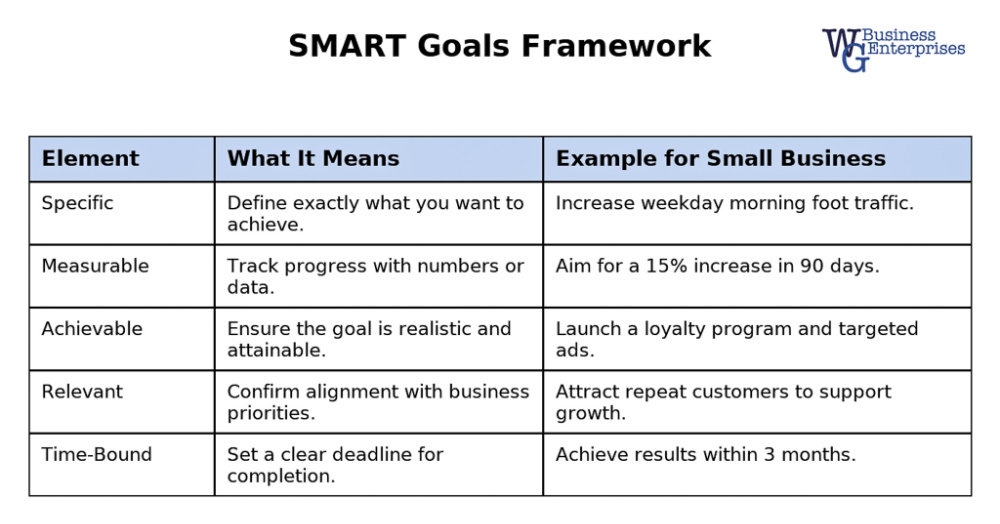
This level of clarity provides a roadmap for action and a clear way to measure success.
Why SMART Goals Matter
Small businesses often struggle with focus, accountability, and consistency. Without a clear framework, goals can become wish lists rather than action plans. SMART goals help overcome these challenges by:
- Providing clarity: Everyone knows what needs to be accomplished.
- Creating measurable checkpoints: Progress can be tracked and wins can be celebrated.
- Ensuring realistic expectations: Ambition is balanced with feasibility.
- Aligning efforts: Teams and leaders work toward the same objectives.
- Building urgency: Deadlines keep projects from stalling.
By converting broad intentions into structured action plans, SMART goals prevent wasted effort and keep your business focused on what truly matters. They also make it easier to adapt. If progress stalls, you can quickly evaluate what’s working and what needs to change.
Another key benefit is motivation. When teams see progress toward a well-defined goal, morale improves.
Achievements, whether big or small, build confidence and create momentum. Over time, this fosters a culture of accountability and success.
Who Should Use SMART Goals?
The short answer is everyone. SMART goals are versatile and can be applied across all levels of business. Here’s how different groups can benefit:
- Entrepreneurs and Startups: Prioritize limited resources and focus on activities with the highest impact. For example, setting a 90-day goal to acquire 50 new customers through targeted outreach.
- Small Business Owners: Apply SMART goals to improve operations, customer retention, or profitability. For instance, reducing customer response time to under 24 hours within three months.
- Corporate Teams: Align departmental projects with overall company objectives. A marketing team might aim to increase qualified leads by 30% in a quarter.
- Leaders and Managers: Set clear expectations for staff, create accountability frameworks, and measure team performance.
For startups, SMART goals act as a compass that provides direction in uncertain times. For established companies, they create consistency across departments and prevent wasted effort on initiatives that don’t support long-term strategy.
How SMART Goals Improve Business Performance
When applied consistently, SMART goals can transform performance in tangible ways:
- Boost Productivity: Focus narrows to the most important activities.
- Improve Decision-Making: Priorities are clear, making choices easier.
- Increase Accountability: Measurable benchmarks keep individuals and teams on track.
- Enhance Performance: Success criteria are explicit, leaving less room for confusion.
- Strengthen Long-Term Strategy: Short-term wins tie directly to the company’s vision.
Companies that embrace SMART goals often see improvements in:
- Collaboration: Teams understand how their work connects to the bigger picture.
- Efficiency: Resources are allocated with precision, reducing waste.
- Timely Project Completion: Deadlines create momentum and prevent delays.
- Culture: Clear goals foster transparency, trust, and shared accountability.
Over time, these benefits compound, creating an environment where everyone is aligned, motivated, and working toward the same vision.
Once your SMART goals are in place, the next challenge is execution. Learn how outsourcing project management can help your business stay on track by reading our post on Why Outsourcing Project Management Helps Businesses Thrive.
Example: A Small Business Using SMART Goals
Let’s bring this to life with a practical example.
Scenario: A boutique coffee shop wants to increase its customer base and profitability.
Breaking it down:
- Specific: Focus is on weekday morning traffic.
- Measurable: Success is defined as a 15% increase.
- Achievable: Loyalty programs and ads are realistic within budget.
- Relevant: Attracting repeat customers supports growth goals.
- Time-Bound: A 90-day deadline creates urgency.
At the end of the quarter, the shop can compare sales data against baseline numbers to measure progress.
They can also analyze which strategies, such as loyalty rewards or social ads, had the greatest impact. This makes it possible to decide whether to continue, adjust, or expand the initiatives.
This ongoing cycle of setting, measuring, and refining ensures goals remain dynamic and responsive, rather than static targets that lose relevance over time.
Case Study: Using SMART Goals to Grow a Coffee Shop’s Customer Base
Business Scenario:
A boutique coffee shop noticed that weekday mornings were slower than expected, which limited overall profitability. The owner wanted to attract more customers during this time without overspending on marketing.
The Vague Goal
“We want more customers.”
While well-intentioned, this goal is too broad. It doesn’t define how many new customers, when growth should happen, or what strategies will be used.
The SMART Goal
“Increase weekday morning foot traffic by 15% within the next 90 days by launching a loyalty rewards program and running a targeted social media ad campaign.”
Breaking It Down by SMART Elements
S – Specific
The goal targets a specific outcome: increasing weekday morning foot traffic.
- Focus area: Weekday mornings (not evenings or weekends).
- Desired change: More in-store customers.
- Strategy: Loyalty rewards + social media advertising.
M – Measurable
The goal includes a quantifiable metric: a 15% increase in foot traffic.
- Baseline: Current average weekday morning customer count.
- Target: Baseline + 15%.
- Tracking method: Daily sales and customer transaction data.
A – Achievable
The strategies are realistic and within the shop’s resources.
- Loyalty program: Easy to implement with existing POS system.
- Social ads: Budget-friendly, highly targeted to local customers.
- Staff capacity: No major increase in workload required.
R – Relevant
The goal supports the business’s broader objectives.
- Aligns with growth strategy: Expanding customer base.
- Boosts profitability: More repeat customers during a slow time.
- Fits the shop’s mission: Building stronger community engagement.
T – Time-Bound
The goal has a clear deadline: 90 days.
- Start date: Beginning of the quarter.
- End date: End of the quarter.
- Review point: Evaluate results and adjust strategy after 90 days.
Results & Next Steps
At the end of the 90-day period, the coffee shop can:
- Compare weekday morning traffic against the baseline.
- See whether the 15% increase was achieved.
- Analyze which strategy (loyalty rewards vs. social ads) had the greatest impact.
- Decide whether to continue, expand, or adjust the campaign.
This structured approach not only creates accountability but also builds a repeatable process for setting and evaluating future goals.
By breaking down a vague intention into a SMART framework, the coffee sho
How to Write Your Own SMART Goals
Creating SMART goals doesn’t have to be complicated. Follow these steps:
- Start with your vision: Identify the big-picture outcome you want.
- Narrow it down: Translate that vision into a specific, focused goal.
- Attach numbers: Define measurable metrics like percentages, revenue, or deadlines.
- Check achievability: Make sure the goal is realistic given your resources.
- Confirm relevance: Ensure the goal aligns with broader business objectives.
- Set a timeline: Without a deadline, goals often stall.
Write your SMART goals down and revisit them weekly. Documenting them makes them tangible, and regular check-ins ensure you stay on track.
Example:
- Vision: “I want to grow my business revenue.”
- Specific: “I want to grow online sales revenue.”
- Measurable: “Increase sales revenue by 20%.”
- Achievable: “Launch two new ad campaigns and optimize the checkout process.”
- Relevant: “This supports my broader goal of scaling e-commerce operations.”
- Time-Bound: “Within the next six months.”
Final SMART Goal: “Increase online sales revenue by 20% within the next six months by launching two new ad campaigns and improving the checkout process.”
This process ensures your goals are not only inspiring but also actionable.

How WG Business Enterprises Helps Clients With SMART Goals
At WG Business Enterprises (WGBE), we’ve seen how SMART goals can unlock measurable success across industries. Many businesses understand the concept but struggle with implementation. That’s where we come in.
We support clients through:
- Operations Consulting: Streamlining workflows so goals are supported by efficient systems.
- Leadership Coaching: Helping executives align vision with actionable objectives.
- Project Management: Turning strategic goals into well-executed initiatives.
Our approach is hands-on:
- We help design SMART goals tailored to your business stage and priorities.
- We create custom SOPs (Standard Operating Procedures) to ensure consistency.
- We build dashboards and tracking systems so you can monitor progress in real time.
- We provide accountability check-ins to keep momentum going.
By embedding SMART goals into your operations, we ensure they become part of your business culture, not just a one-time exercise.
Free Resource: SMART Goals Guide
Ready to start applying SMART goals in your own business?
Download our Free SMART Goals Guide, a step-by-step template designed to help you:
- Define goals that fit your business stage and resources.
- Track progress with measurable outcomes.
- Keep your team aligned with deadlines and accountability.
- Adjust strategies based on real-world results.
This guide takes the guesswork out of goal-setting and gives you a practical tool you can start using today.
Common Questions About SMART Goals in Business
1. What does SMART stand for in SMART goals?
SMART stands for Specific, Measurable, Achievable, Relevant, and Time-Bound. Each element helps ensure goals are clearly defined, realistic, and trackable.
2. Why are SMART goals especially useful for small businesses?
Small businesses often operate with limited time and resources. SMART goals provide focus, accountability, and measurable benchmarks, allowing owners to prioritize what matters most and achieve sustainable growth.
3. How often should SMART goals be reviewed?
SMART goals should be reviewed regularly—ideally weekly or monthly. Frequent check-ins help track progress, highlight challenges early, and keep the team motivated and aligned.
Conclusion and Next Steps
SMART goals are more than a productivity tool, they’re a roadmap for sustainable success. By setting goals that are specific, measurable, achievable, relevant, and time-bound, you give your business the clarity, structure, and accountability it needs to grow with purpose.
If you’re looking for additional ways to strengthen your operations, explore our guide on Business Optimization Tips for practical strategies that complement the SMART goals framework.
At WG Business Enterprises, we believe every business deserves a clear path to success. Whether you’re just starting out or preparing to scale, SMART goals can transform the way you operate by turning vision into measurable results.
Take the first step today. Download our free SMART Goals Guide or schedule a free consultation with our team. Let’s turn your big-picture vision into actionable milestones that drive lasting success.

More Free Business Resources & Ebooks:
Free Guide to Optimizing Your Business
Free Guide to Hassle-Free Office Move