
(Vlad Deep/ Pexels)
Business growth creates new opportunities, but it also increases complexity. As a business expands, managing employees, customers/clients, projects, and daily operations becomes more challenging. Without clear systems and processes, growth can quickly create confusion, inefficiencies, and unnecessary strain on both leadership and employees.
Scaling successfully requires structure that grows alongside the business. From documented processes and project management systems to data-driven decision-making and operational planning, the right framework helps businesses maintain control while continuing to grow. In this comprehensive guide, we examine why organizational structure breaks down during growth and detail seven battle-tested strategies to help you scale sustainably.
Table of Contents
What Does It Mean to Scale a Small Business?
Scaling a small business means increasing revenue, customers, and operational capacity without sacrificing efficiency, quality, or profitability. While growth often involves adding new employees, services, or locations, scaling focuses on creating systems and processes that can support increasing demand in a sustainable way. Businesses that scale successfully build the structure needed to handle growth, allowing them to serve more customers and take on new opportunities without creating unnecessary operational challenges.

(Felicity Tai/ Pexels)
Why Businesses Lose Structure During Growth
Growth creates new opportunities, but it also introduces operational complexity. Many businesses begin experiencing structural challenges not because growth is a problem, but because their systems, processes, and decision-making frameworks have not evolved alongside their expanding operations.
Common reasons businesses lose structure during growth include:
- Processes remain informal for too long. What once worked through verbal communication and quick decisions becomes difficult to manage as the team grows.
- Roles and responsibilities become unclear. As new employees join, accountability can become blurred, leading to duplicated work, missed tasks, and confusion about ownership.
- The business becomes overly dependent on the owner. When every major decision, approval, or problem must go through one person, growth can quickly outpace leadership capacity.
- Communication becomes more complex. Information that was once shared naturally in a small team can become fragmented across departments, projects, and locations.
- Policies and procedures are not documented. Without consistent guidelines, employees may handle similar situations differently, creating inconsistency for both customers and team members.
- Technology and systems fail to scale. Businesses often continue using tools and processes designed for a smaller operation, creating inefficiencies as demand increases.
- Growth happens faster than operational planning. New customers, services, or employees are added before the necessary infrastructure is in place to support them.
- Decisions are made reactively instead of strategically. Teams spend more time solving immediate problems than building systems that support long-term growth.
- Performance is not measured consistently. Without clear metrics and reporting, it becomes difficult to identify bottlenecks, allocate resources effectively, or plan for future growth.
- Knowledge is concentrated with a few employees. Important information stored in individual inboxes, spreadsheets, or employee memory creates risk when responsibilities shift or team members leave.
While these challenges often develop behind the scenes, they eventually begin affecting daily operations. Employees become less efficient, customer experiences become inconsistent, and leadership spends more time solving problems than planning for growth. Recognizing these warning signs early can help businesses address underlying issues before they begin impacting performance and scalability.

5 Warning Signs Your Business Is Outgrowing Its Current Systems
Structural issues rarely appear all at once; instead, they show up as recurring operational challenges that slowly consume more time, create frustration, and make growth harder to manage. If any of the following situations sound familiar, it may be a sign that your business has outgrown its current systems.
1. The Same Questions Keep Being Asked
If employees repeatedly ask questions such as:
- “How do I handle this client request?”
- “Where can I find that form?”
- “Who approves this?”
- “Has this process changed?”
Your business may be relying too heavily on verbal instructions and employee memory rather than documented procedures.
When employees depend on verbal guidance for routine tasks, training takes longer, mistakes become more frequent, and consistency becomes harder to maintain as the business grows.
2. The Owner Becomes the Bottleneck
One of the most common scaling challenges occurs when every important decision flows through the business owner.
For example:
- Employees wait for approval before sending a proposal.
- Managers cannot make purchasing decisions without leadership input.
- Projects stall while awaiting feedback from one person.
- Team members constantly interrupt the owner with routine questions.
What once felt like maintaining control can quickly become a growth limitation. If progress slows whenever the owner is unavailable, the business may be too dependent on a single individual.
3. Customer Experience Starts Varying From One Employee to Another
A growing business should deliver consistent service regardless of who is performing the work.
Warning signs include:
- Different employees provide different answers to the same customer question.
- Client onboarding experiences varying between departments.
- Projects being completed differently depending on who manages them.
- Customer complaints are increasing despite sales growth.
When consistency begins to disappear, it often signals that processes have not been standardized as the business expands.
4. Important Information Lives in Emails, Spreadsheets, and People’s Memories
Imagine a team member takes a vacation or leaves the company.
Suddenly nobody knows:
- Where the latest client documents are stored.
- How a recurring process is completed.
- Which spreadsheet contains the correct data.
- Or who was responsible for the next step
As businesses grow, information scattered across inboxes, desktop folders, sticky notes, and personal spreadsheets creates operational risk. Without centralized documentation, organizations become vulnerable to delays, confusion, and costly mistakes.
5. Leadership Spends More Time Solving Problems Than Planning Growth
Growth should create opportunities, not constant firefighting.
You may be outgrowing your current systems if leadership spends most of its time:
- Resolving employee confusion
- Tracking down missing information
- Addressing project delays
- Fixing process failures
- Responding to customer complaints
- Or reorganizing priorities every week
When daily operational issues consume leadership’s attention, strategic planning often gets pushed aside. Over time, this makes it increasingly difficult to focus on expansion, innovation, and long-term growth goals.
Recognizing these warning signs is the first step toward maintaining structure during growth. The good news is that many of these challenges can be addressed with the right systems, processes, and planning. The following strategies can help your business build a stronger foundation for sustainable growth.
(Ann H/ Pexels)
7 Strategies for Scaling a Small Business Without Losing Structure
Sustainable growth depends on having the right systems, processes, and operational structures in place to support increasing demands. Businesses that maintain structure during growth are often the ones that take a proactive approach to planning, communication, resource management, and accountability.
The following strategies can help small businesses build a strong foundation for growth while maintaining the efficiency, consistency, and organization needed for long-term success.
1. Create Standard Operating Procedures Before You Need Them
Many small businesses rely on verbal instructions and on-the-job training during their early growth stages. While this may work with a small team, it becomes much harder to maintain consistency as new employees, customers, and projects are added.
Start by documenting recurring processes before growth creates confusion. Focus first on activities that happen regularly, such as client onboarding, invoice approvals, proposal creation, customer support requests, employee onboarding, and project handoffs. Storing these procedures in a shared location allows employees to follow the same process regardless of who is completing the task.
Tools such as Notion, SharePoint, Trainual, Process Street, or even a shared Google Drive can help organize procedures, templates, and checklists. Some businesses also create short screen-recorded walkthroughs using tools like Loom to make training and knowledge transfer easier.
As processes become more documented, businesses reduce training time, improve consistency, and create a stronger foundation for growth.
For additional guidance on creating organizational structure and consistency, explore our article on Top 5 Business Policies Every Growing Company Needs, which explains how policies and procedures support growing businesses.
Growth Checkpoint: If a key employee took a two-week vacation tomorrow, could someone else successfully perform their responsibilities using existing documentation?
2. Build Capacity Plans Before Hiring New Employees
Hiring new employees can support business growth, but adding staff too early or without a clear plan can create unnecessary costs and management challenges. Before expanding the team, evaluate whether existing employees are operating at capacity and identify where workloads are creating bottlenecks.
Start by reviewing how work is currently distributed. For example, if project managers are consistently overseeing more projects than they can effectively manage, or customer inquiries are taking longer to resolve because one employee handles all support requests, these may be indicators that additional resources are needed. Tracking workloads can help distinguish between a staffing issue and a workflow issue.
A simple way to track capacity is by measuring how work is distributed across the team. For example, businesses can track the number of active clients assigned to each account manager, the number of projects overseen by each project manager, or the hours employees spend on billable and non-billable work each week. Conducting regular workload reviews can help identify overloaded team members and reveal whether operational improvements or additional staffing are needed.
Tools such as Microsoft Planner, ClickUp, Asana, and even simple Excel spreadsheets can help businesses monitor workloads, project assignments, and resource availability. This visibility allows leaders to make hiring decisions based on actual business needs rather than assumptions.
Taking a proactive approach to capacity planning helps businesses allocate resources more effectively, avoid employee burnout, and ensure new hires are brought in at the right time and for the right roles.
Growth Checkpoint: Are hiring decisions based on measurable workload demands, or does the team simply feel busy?
3. Establish a Project Management System for Growth Initiatives
As businesses grow, they often take on larger projects that involve multiple employees, departments, vendors, or clients. Without a structured system for managing these initiatives, important tasks can be overlooked, deadlines can slip, and responsibilities can become unclear.
Rather than tracking projects through email chains or scattered spreadsheets, create a centralized system that assigns ownership, tracks deadlines, and monitors progress. For example, if your business is launching a new service, implementing software, hiring a new department, or expanding into a new market, a project management tool can help keep everyone aligned throughout the process.
Platforms such as Asana, ClickUp, Monday.com, Trello, and Microsoft Project allow teams to organize tasks, assign responsibilities, and track milestones in one place. Having visibility into project status helps leaders identify potential delays before they impact broader business goals.
As businesses scale, project management becomes increasingly important for maintaining accountability and ensuring strategic initiatives stay on track. To learn more, explore our article on Why Do Growing Businesses Need Project Management Support?
Growth Checkpoint: Can every major project in your business be linked to a designated owner, defined deadline, and measurable objective?

(Gustavo Fring/ Pexels)
4. Centralize Business Knowledge Instead of Storing It in People’s Heads
As a business grows, important information often becomes scattered across email inboxes, personal spreadsheets, sticky notes, and individual employees’ memories. While this may seem manageable at first, it can create significant challenges when employees change roles, take time off, or leave the company.
Create a central location where employees can easily access procedures, templates, client information, policies, forms, and training materials. For example, instead of having onboarding documents saved on one manager’s computer, store them in a shared system that all authorized team members can access when needed.
Tools such as SharePoint, Notion, Confluence, and Google Drive can help organize business information and ensure employees are working from the same source of information. Centralizing knowledge reduces confusion, shortens training time, and helps maintain consistency as the business expands.
Growth Checkpoint: If a key employee unexpectedly left the company tomorrow, would your team know where to find the information needed to continue operating effectively?
5. Use Data to Allocate Time, Money, and Resources
As businesses grow, decisions become more expensive. Hiring a new employee, investing in marketing, adding a new service, or purchasing new software all require resources. Without reliable data, these decisions are often based on assumptions rather than actual business performance.
Look beyond revenue to understand what is actually contributing to profitability. For example, compare the revenue, costs, and time required to deliver each service. A service that generates significant revenue may not be the most profitable if it requires substantial resources. These insights can help guide pricing, staffing, and investment decisions.
Time is another resource worth tracking. If employees spend hours each week on repetitive administrative tasks or manual reporting, it may be an opportunity to streamline workflows, standardize processes, or introduce automation. Likewise, monitoring workloads can help determine whether delays are being caused by staffing shortages or inefficient processes.
Marketing and growth investments should be evaluated the same way. Track lead generation, customer acquisition costs, conversion rates, and customer retention to identify which efforts are producing results. To learn more about using data to support business decisions, read our article How Data Analytics Helps Small Businesses Grow.
Growth Checkpoint: Are you using data to decide where your next dollar, hour, or employee should be allocated?
6. Reduce Owner Dependency Through Decision Frameworks
One of the biggest obstacles to scaling is when every important decision depends on the business owner. While this may work in the early stages, growth becomes difficult when approvals, questions, and problem-solving continuously flow through a single person.
Instead of centralizing every decision, create clear decision-making frameworks that define who is responsible for what. One common example is the RACI Framework, which identifies who is Responsible, Accountable, Consulted, and Informed for a particular task or project. This helps eliminate confusion and ensures employees know when they can make decisions independently. For example, during a software implementation, the IT manager may be responsible for execution, the owner accountable for final approval, department leaders consulted for requirements, and employees informed about upcoming changes.
Another practical approach is Delegation of Authority (DOA), a framework used by many growing organizations to establish approval limits. For example, a department manager may be authorized to approve purchases up to $1,000, while larger expenses require executive approval. Creating these boundaries allows decisions to move faster while maintaining oversight.
Businesses can also use the Eisenhower Matrix to prioritize leadership involvement. Tasks that are important but not urgent can often be delegated or scheduled, while only high-priority decisions require direct involvement from ownership. For example, responding to a customer complaint may require immediate attention, while updating internal procedures can be scheduled for a later date or assigned to a manager. This helps owners spend more time on strategic planning and less time addressing routine operational issues.
As employees gain clear responsibilities and decision-making authority, businesses become less dependent on a single individual and better positioned for sustainable growth.
Growth Checkpoint: If you stepped away from the business for one week, what decisions would immediately come to a halt?
7. Schedule Quarterly Operational Reviews
Growth can expose operational issues that are not always visible in day-to-day activities. Setting aside time each quarter to review business performance helps leaders identify bottlenecks, evaluate systems, and make adjustments before small issues become larger problems.
Many businesses conduct quarterly operational reviews at the end of each quarter to assess key areas such as staffing, workload distribution, customer feedback, project performance, and financial results. For example, if customer response times have increased, projects are regularly delayed, or employee workloads have become uneven, a quarterly review creates an opportunity to identify the root cause and develop a plan to address it.
A structured review does not need to be complicated. Consider scheduling a half-day leadership meeting every 90 days to discuss what is working well, what challenges emerged during the quarter, and what operational improvements should be prioritized moving forward. Reviewing performance metrics, project outcomes, and team feedback together can help ensure growth remains aligned with business goals.
Regular operational reviews create a consistent process for continuous improvement and help businesses make proactive decisions rather than reacting to problems after they occur. For additional guidance on creating a long-term growth review process, explore our article on Quarterly Checkpoints for Sustainable Business Growth.
Growth Checkpoint: If your leadership team met tomorrow to discuss the last 90 days, would you have clear data and documented feedback to identify what should be improved next quarter?
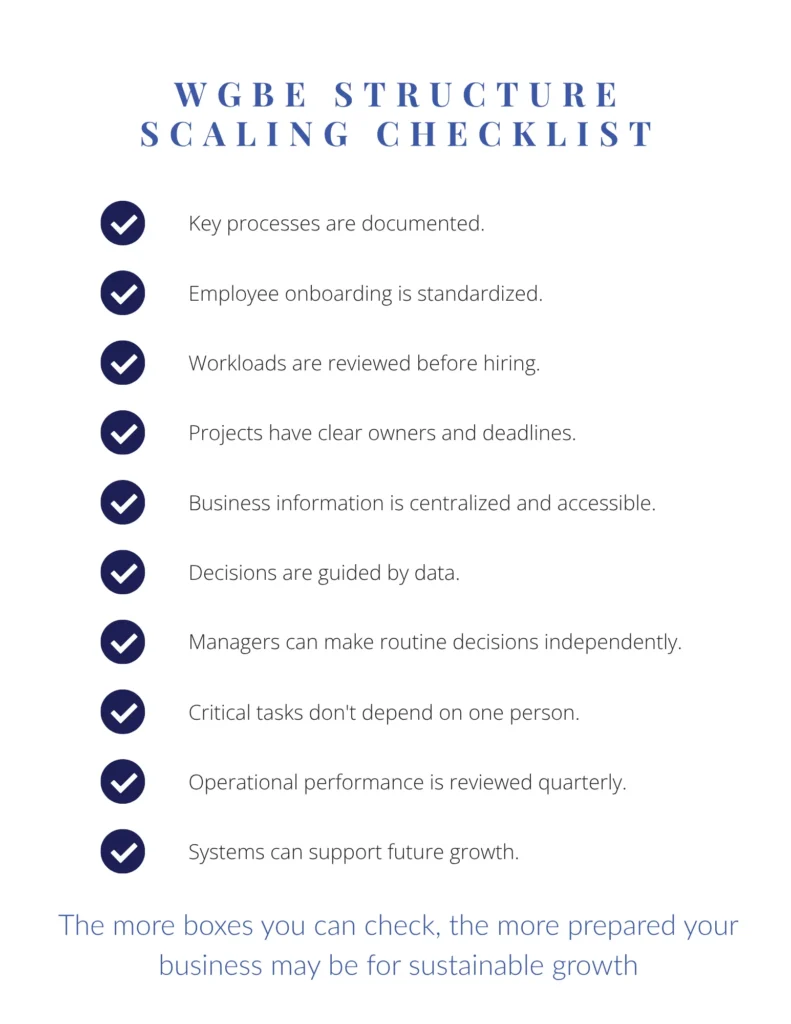
The Structure Scaling Checklist
As your business grows, it’s important to evaluate whether your systems are keeping pace with increasing demands. Use this checklist as a quick self-assessment to identify areas that may need attention before growth creates larger operational challenges.
Scaling with Structure: The WGBE Approach
Recognizing growth challenges is one thing. Creating the systems, processes, and operational structure needed to support long-term growth is another. Many business owners understand where bottlenecks exist but struggle to find the time or internal resources needed to address them while managing daily operations.
At WG Business Enterprises, we help growing businesses build the operational foundation needed to scale with confidence. From developing policies and procedures to improving project management, organizational structure, and strategic planning, our approach focuses on creating sustainable systems that support growth without adding unnecessary complexity.
Whether your business is preparing for expansion, struggling with operational bottlenecks, or looking to strengthen its internal processes, WGBE can help create practical solutions aligned with your long-term goals.
Frequently Asked Questions
1. What does it mean to scale a small business?
Scaling a small business means increasing revenue, customers, and operational capacity without a proportional increase in costs or complexity. Successful scaling allows a business to grow while maintaining efficiency, consistency, and profitability.
2. Why do businesses lose structure during growth?
Businesses often lose structure when growth outpaces their systems and processes. As new employees, customers, and projects are added, informal workflows, undocumented procedures, and unclear responsibilities can create confusion and operational bottlenecks.
3. How can a small business grow without creating operational chaos?
Businesses can maintain structure during growth by documenting processes, implementing project management systems, centralizing information, using data to guide decisions, and regularly reviewing operations to identify challenges before they become larger issues.
4. When should a business create policies and procedures?
Businesses should begin documenting policies and procedures before growth creates operational challenges. Creating clear guidelines early helps maintain consistency, improve training, and reduce confusion as the organization expands.
5. How does project management support business growth?
Project management helps businesses organize tasks, assign responsibilities, track progress, and manage resources effectively. As projects become larger and more complex, project management provides the structure needed to keep initiatives aligned with business goals and completed on time.
Your Growth Action Plan
Scaling a business successfully requires more than increasing revenue. It requires the systems, processes, and operational structure needed to support growth without creating bottlenecks, confusion, or unnecessary strain on your team.
Where to Start This Week: Identify one recurring process that regularly causes delays, confusion, or repetitive questions and document it. Whether it’s client onboarding, project approvals, or employee training, creating structure in one area can be the first step toward building a more scalable business.
Next Steps
If your business is preparing for its next stage of growth, WG Business Enterprises can help you build the foundation for sustainable success through process improvement, project management support, strategic planning, and organizational development. Schedule a free consultation today and discover how WGBE can help your business scale with structure and confidence.
Serving West Palm Beach, Palm Beach County, and clients across the U.S.A

Free Business Resources & E-Books
Free Guide to Optimizing Your Business
Free Guide to Quarterly Checkpoints