When a business moves beyond the startup phase, expansion becomes the primary driver of most departmental decisions. Growing businesses require additional staff, responsibility redistribution, marketing expansion, and much more. For a company to sustain proper scaling capacity, executing daily operations efficiently is essential.
Often, many do not realize how significantly a company’s growth rate affects the executive administration and other departments. This can create bottlenecks in several areas, despite the administration’s best efforts. If this sounds like your company, or if you notice your company beginning to struggle with growth in other ways, it may be time to consider hiring an fCOO (Fractional Chief Operations/Operating Officer).
Table of Contents
fCOOs in Growth-Stage Settings
A growth-stage company is ready for the next chapter of expansion and an authentic reputation. Companies in this stage just need the right steps to get there. By hiring an fCOO, companies can more easily address and identify common issues caused by growth in multiple areas. In addition, an fCOO’s part-time structure starts at nearly half the cost of a full-time executive so businesses can better utilize their revenue potential. But, how do you know if that is where you company is and what the next steps are.
How Do You Know When a Company Has Reached the Growth Stage?
Every company’s foundation begins at different stages to build upon. Once a startup business significantly increases its sales and requires a need for additional management, it could be entering its growth stage. Generally, what indicates a growth stage is an increase in demand and a need for greater capacity in many or a few areas. This simply means that more customers are willing to pay for your services or products, but this requires updates within a business for sustained success.
More specifically, a growth-stage company can be defined by how its founders identify it through specific variables. Generally, these variables include a staff ranging between 15 and 75 employees, revenue ranging between 2 and 20 million annually, or a company reaching post-funding milestones and/or bootstrapped profitability. A founder will be able to immediately recognize whether their company meets these specific margins.
General stats for the growth stage can include the following:
- Strong growth that exceeds 100% each year.
- An annual revenue growth rate added to a company’s profitability should equal or surpass 40%.
- Money spent on sales (CAC) and total expected revenue from a customer-company relationship (LTV) should allow for a ratio of 3:1. For every dollar spent, you earn three dollars over time.
- Percentage of recurring revenue from consistent customers should meet or exceed 120%.
If you are there, then it maybe time to look towards the next chapter. Don’t worry, though if you are not quite there yet as these issues could still come up and you will want to tackle them right away.
Common Growth-Stage Drawbacks
An fCOO can address multiple common issues that expanding companies face:
Leadership and Operational Transitions
Often, companies run the same way they have when they became a sturdy small business. Founders and administration often fail to recognize the need to delegate, reassign and create new roles, and remove old operations that are no longer supporting departments or the business. However, lack of time can often be a large part of why many of these aspects go untouched and are instead managed by only a few people in upper management or the founders themselves. An example of this can be presented as a founder continuing to demo products or a CEO manually signing off on invoice approvals. You might even see a lack of written SOPs or management relying on too few project management tools.
System Bottlenecks
Along with operations, the systems set into place from the beginning are in need of updates or replacements. These systems can range anywhere from software and tech to hiring processes and scheduling. Companies that experience fast growth and revenue rates spend too much time surviving old systems instead of rethinking them. There is too much input to manage and not enough time to focus on output and system setup. In this scenario, companies rely on outdated apps, manual data tracking, email-managed onboarding, lack of shift coverage tools, overall management, and HR bottlenecks that affect daily operations.
Financial Changes and Pressures
Because there is an increase in customers, revenue skyrockets. Though this is the overall goal, an evolving company can struggle with spending too much of this revenue. Costs can be lost to an overflow of new employees, hidden costs of having new customers, and general supplies needed to run a business. In these situations, spending is often unchecked and can potentially roll a company backwards. Because of this, other circumstances are created surrounding overlapping jobs without clear boundaries, excess time dedicated to customer personalization, refund costs, and premature investments in furniture and brand merchandise.
Marketing and Company Focus
Marketing, even if it has undergone past updates, would require a substantial change to fully support a growth-stage business. Marketing and advertising quality and frequency, accepting more polished products and support systems, and focusing on a specific brand niche are important for a business at the rapid growth level. Companies can often lose focus on the mission they based the company upon or spend too much time chasing unrelated investments of time and money. These investments can include expensive advertising, influencer investments, and hiring an agency to relaunch a brand before a company is ready and has proof of profit in most areas.
Beyond these examples, there can be many setbacks unique to individual companies. For a company of this capacity to struggle in certain areas, it is not necessarily going to relate to all of these specific aspects. Oftentimes, it requires another professional voice to step in to assist those who are doing well to better reach their highest potential.
How an fCOO Can Help
An fCOO helps meet the needs of various businesses and assists them in gaining the potential to reach their goals. There are many ways an he/she can address bottlenecks and organizational setbacks. Below are examples of how and why an fCOO could benefit any growth-stage company.
Benefits and Services Outline
Some impactful fCOO deliverables include the following:
Increasing a CEO’s Organizational Proficiency
An fCOO works to enable the CEO and their supporting team. Their focus is on carefully analyzing a CEO’s organizational habits and offering them a fresh perspective on their company. This can involve bettering the company’s mission implementation, the daily tasks of a CEO and their team, and training company leaders to be aware of bottlenecks and maintain functionality in their departments.
Careful Assessment and Reinvention of Operational Infrastructure
An fCOO restructures where a company is struggling in other departments and trains managers on how to fulfill an effective plan through their employees. This can involve reorganizing team roles, implementing software assistance, and addressing new ways of daily operation. A company will be left with organizational proficiency from the CEO to its newest members in supporting departments.
Addressing Where Marketing and Growth are Affecting Output
Rapid growth can come on quickly once a company has reached beyond its start-up point. An fCOO will acknowledge where marketing no longer supports and encourages an environment that allows teams to use an increased income in the best ways. This environment can allow a company to better identify where income can be lost and ease into a more stable system.
Financial Flexibility and Professionalism
fCOOs offer professional opinions and plans without placing a financial burden upon companies. fCOOs cost vs. full-time executive pay is significantly lower in comparison, being nearly half the financial burden.
Signs Your Growing Business Needs an fCOO
Growth-stage companies can be well-suited for a variety of reasons. Many of those reasons, however, can center around daily operations in one or multiple areas. Here are some signs your company may require an fCOO’s assistance:
- Goal execution and accountability failures in departments.
- Organizational and work environment struggles.
- Work overload causing business quality performance to drop.
- Reliance on old systems and software that create extra work to utilize.
- Loss of overall company focus and mission.
- Placing multiple responsibilities upon managers and/or executive administrators.
- Losing time due to newfound expectations in rapid growth.
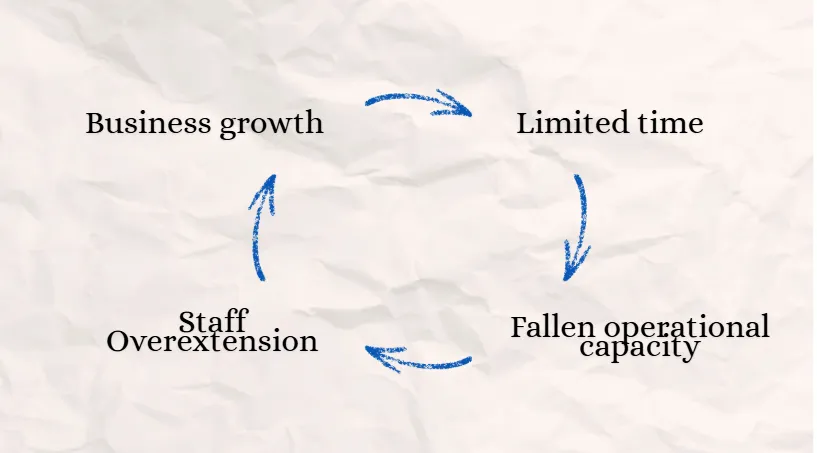
In addition to collective issues, the growth stage brings cycles that are often caused by individual setbacks. If you find your company has a set of unhelpful cycles in departments and management, it could be a sign you need an fCOO’s advice for operational bottlenecks in scaling companies. Below is an example of one cycle many growth-stage companies confront often. Many companies cannot fully grasp just how much cycles like this negatively impact service, revenue, work environment, workflow, and more. It is a cycle that begins with rapid business growth. Due to increasing revenue and demand, there is limited time for staff and founders to think of supporting much else, straining unrefined processes. Systems and leadership remain unchanged, but more of a rushed business which often leads to a fallen operational capacity and staff overextension. The leadership is then more prone to decreasing operational fires than management and delivery:
What You Should Know About an fCOO
It is important to understand the primary purposes of an fCOO beforehand. An fCOO’s main goal is to enable, inform, and implement important operational elements that a company is missing or needs to improve. Here are a few other aspects that are essential to understand:
- An fCOO does not handle legal or financial setbacks for companies. These areas may require a specialist’s help and advice. This includes billing, taxes, investments, accounting, long-term treasury management, and specialized R&D.
- An fCOO can enable company structures, schedules, and environments to empower companies to handle these items themselves or with a specialist. The goal is to strategize and put plans into place by embedding within the company and building an environment for success. This is done through improving operational planning and decisions.
If you are unsure about whether an fCOO will benefit your company, it may be helpful to take WGBE’s Free Business Assessment. While an fCOO focuses on structural systems and departmental accountability, some leaders only need executive-level strategic support. If you are debating between organizational overhaul and high-level project alignment, read our breakdown on Fractional COO vs Fractional Chief of Staff to see which best matches your stage and when to hire an fCOO.
Frequently Asked Questions
1. What Stages of Expansion are Most Difficult to Manage?
Transition points such as founder-led to middle-management delegation and increasing staff from 10 to 30 people can be significantly difficult to manage. These transitions often result in communication and system issues. However, any stage that affects employee numbers, additional projects, process transitioning, and workflow can be difficult to manage in any situation.
2. Why Hire an fCOO instead of a Consultant or Project Manager?
This depends entirely on a company’s needs. It is best determined by understanding the roles of each professional. Consultants offer advice on how to better a business, project managers give tasks to teams for a specific outcome, and fCOOs embed themselves within the company to manage people and systems with the long-term in mind.
3. What Services can an fCOO not Offer Growth-Stage Companies?
An fCOO tends to stay away from assisting with legal or financial aspects of a company directly. However, an fCOO can assist those in charge of these items by implementing personalized systems for better growth and daily operations and can also provide some resources or suggest some other experts to connect with.
4. What Areas of a Growth-Stage Company Benefit Most from an fCOO?
Growth-stage companies often find themselves struggling with systems, leadership, marketing, and financial changes very rapidly. An fCOO benefits this type of company in any areas that are affected by these common struggles. He/She is focused on impact that ripples throughout the company as a whole.
5. When Will a Company See Results from an fCOO’s Assistance?
Upgrades such as establishing meeting frequencies and discovering apparent bottleneck improvements can be apparent within the first 30 days. More structural enhancements like tech migrations, team accountability, and operational planning and decision-making develop within 90 to 180 days.
Next Steps
Ready to Explore New Ways of Growth?
If you are hoping to enhance your strategy for your rapidly growing business, WG Business Enterprises can assist you! Contact Whitney to create a personalized plan for your company’s growth goals by scheduling a free consultation today.
Serving West Palm Beach, Palm Beach County, and clients across the U.S.A
Free Business Resources & E-Books
Free Guide to SMART Goals for Businesses
Free Guide to Optimizing Your Business
Free Guide to Quarterly Checkpoints
Connect with Us on Social Media